






A new interactive tool developed by UCL enables IMO member states to better understand the shipping activity and emissions associated with international shipping serving their country.
London, 27th August 2026 – New research suggests that 10% of international shipping emissions occur within port areas globally. The finding offers hope that these emissions can be effectively mitigated via mature electrification technologies such as cold ironing at berth, switching to battery electric propulsion whilst idling or manoeuvring at port and converting vessels engaged with short-sea routes to battery-operated electric vessels.
Presented as an interactive tool on the UCL Shipping and Oceans Research Group website, the ‘Shipping GHG Emissions Explorer’ aims to improve the evidence base supporting IMO negotiations due to resume next week on the adoption of the Net Zero Framework (NZF). Built using a dataset of 1.2 million voyages undertaken by over 43,000 unique vessels across a single year, the tool offers IMO delegations visibility on which of 575 million tonnes of CO2e emissions generated by international shipping can be attributed to their country’s economic activity.
James Stewart, Research Fellow in the Analytics of Energy and Transport at the UCL Shipping and Oceans Research Group commented: “Although imperfect, AIS-centred big data approaches have revolutionised our ability to understand key trends in the energy demands and GHG emissions associated with international shipping activity. The tool offers users the chance to benefit from this unprecedented clarity by exploring aggregate data directly on the platform, and interested parties are encouraged to validate the statistics with any complementary datasets they may have access to.”
The tool offers energy demand and GHG emission statistics during port and voyage phases alongside disaggregation possibilities by vessel type, port and maritime trade partner, enabling users to explore key trends in international shipping activity. Future updates to the tool slated for release in September will provide users with additional statistics on state-level seaborne trade volumes and potential economic impacts of the proposed amendments to the IMO NZF ahead of their potential for adoption later in the year.
Yoseph Ismail, Research Assistant at the UCL Shipping and Oceans Research Group commented: “Having the ability to breakdown international voyages by their ‘In port’ and ‘In voyage’ emissions has given us significant insight into what benefits electrification in port could bring. Our granular approach has allowed us to discover key trends in the country data. For instance, 7 out of 10 countries in Latin America/Caribbean and 8 out of 10 in East Asia Pacific that have the highest in port emissions are small island nations. These countries emissions, are all well above global and regional averages, and often above 20%. Further analysis into the reasons for this could go a long way towards finding the most cost-effective solutions to bring down emissions.”
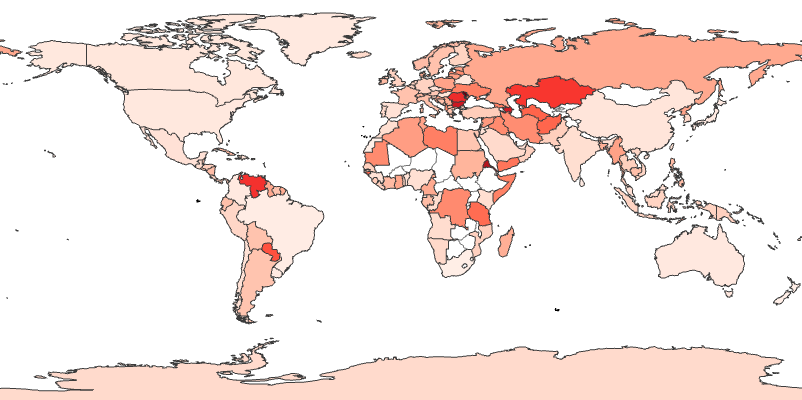
Share of ‘in port’ GHG (CO2e) emissions by country
Link to beta version of the tool (temporary link – The tool will be available in the Shipping and Oceans website on 27th August 2026): https://shipping-explorer-production.up.railway.app/
About UCL Energy Institute
The UCL Energy Institute hosts a world leading research group which aims to accelerate the transition to an equitable and sustainable energy and trade system within the context of the ocean. The research group’s multi-disciplinary work on the shipping and ocean system leverages advanced data analytics, cutting-edge modelling, and rigorous research methods, providing crucial insights for decision-makers in both policy and industry. The group focuses on three core areas: analysing big data to understand drivers of historical emissions and wider environmental impacts, developing models and frameworks to explore energy and trade transition to a zero emissions future, and conducting social science research to examine the policy and commercial structures that enable the decarbonisation of the shipping sector. For more information visit www.shippingandoceans.com
