





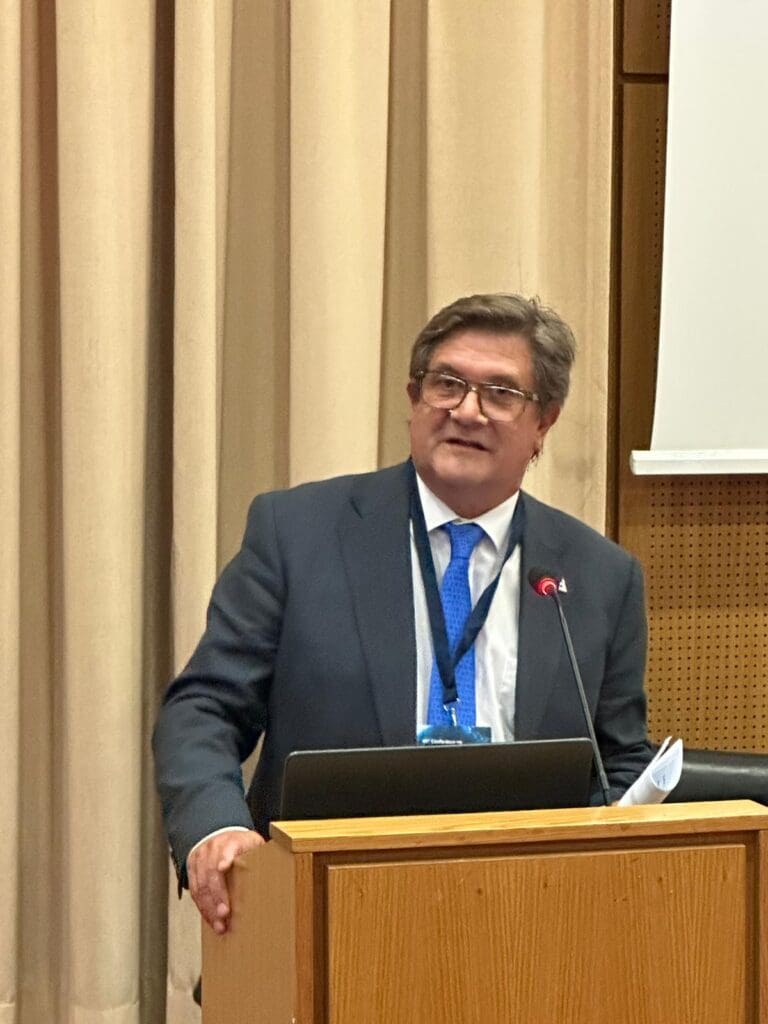
“Compliance Must Strengthen Maritime Safety, Not Compete with It”
Athens, 21 September 2026
The growing operational, investment and financial pressures created by expanding maritime compliance obligations were highlighted by George C. Xiradakis, Founder & CEO of XRTC Business Consultants Ltd and President of the Association of Banking and Financial Executives of Hellenic Shipping, during the 49th Annual Conference on Oceans Law and Policy.
The Conference took place on 21 September 2026 at the Headquarters of the National and Kapodistrian University of Athens. Mr Xiradakis participated in Panel IIIA: “Maritime Security and the IMO,” which examined the central role of the International Maritime Organization in developing effective global regulatory and governance frameworks as maritime security challenges become increasingly complex and interconnected. The panel was chaired by Professor Ronán Long, Director of the WMU-Sasakawa Global Ocean Institute and Nippon Foundation Professorial Chair of Ocean Governance and the Law of the Sea at the World Maritime University. The panel featured the following interventions:
- “The IMO Legal Committee Work on Contemporary Maritime Security Threats and Fraudulent Ship Registration”, presented by Dr Dorota Lost-Siemińska, Director of the Legal Affairs and External Relations Division of the IMO.
- “The Development of the Concept of Maritime Security from the Perspective of the IMO”, presented by Professor Atsuko Kanehara, Research Director at the Canon Institute for Global Studies and Senior Fellow at the Sasakawa Peace Foundation.
- “Shipping Under Pressure: Managing Maritime Operations and Investments in an Era of Expanding Compliance Obligations”, presented by Mr George C. Xiradakis, President of the Association of Banking and Financial Executives of Hellenic Shipping and Founder and Managing Director of XRTC Business Consultants Ltd.
- “Protecting the Ship, the Seafarer and the Signal: The IMO’s Recent Regulatory Practice against Contemporary Maritime Security Threats”, presented by Dr Sanjeet Ruhal, The Nippon Foundation Lecturer at the IMO International Maritime Law Institute.
Mr Suriya Sundararajan of the WMU-Sasakawa Global Ocean Institute served as the panel’s Rapporteur.

In his intervention, Mr Xiradakis underlined that maritime security can no longer be viewed solely through the traditional challenges of piracy, armed robbery and physical attacks against vessels. It now encompasses a much wider range of regulatory, geopolitical, technological, operational and financial risks. Shipping companies must comply simultaneously with IMO conventions, regional regulations, national legislation, sanctions regimes, environmental requirements, cybersecurity standards and the contractual expectations of charterers, insurers and financial institutions.
“Compliance is no longer a separate administrative function. It has become an integral part of the operational and financial architecture of shipping,” Mr Xiradakis stated. He stressed that, during geopolitical crises, shipping companies may be required to reassess voyages within hours. New sanctions, attacks against commercial vessels, changes in war-risk areas and restrictions affecting cargoes, counterparties or financial transactions can immediately influence operational decisions.
The central challenge is to translate legal and regulatory requirements into safe, lawful and commercially viable decisions concerning port access, cargo transportation, insurance coverage, financing and, above all, the protection of vessels and seafarers. Mr Xiradakis placed particular emphasis on the investment uncertainty confronting shipowners. The maritime industry is being asked to renew its fleet, reduce emissions, adopt alternative fuels and invest in new technologies, even though many of the required solutions remain commercially uncertain or unavailable at the necessary scale.
“Shipowners are making investment decisions today for vessels expected to operate for the next twenty or twenty-five years, without knowing which fuels, technologies or regulatory standards will ultimately prevail,” he noted. The same uncertainty presents significant risks for shipping banks. Lenders must now assess not only borrowers’ creditworthiness and vessels’ market values, but also sanctions exposure, environmental performance, climate-transition risk, technological viability and the integrity of every counterparty involved. Regulatory uncertainty can directly affect collateral values, loan-to-value ratios, financing covenants and the availability and cost of capital.
Mr Xiradakis warned that this creates a fundamental contradiction: shipping requires unprecedented investment to achieve its environmental and technological transition at precisely the moment when regulatory and technological uncertainty may make access to finance more difficult and expensive.
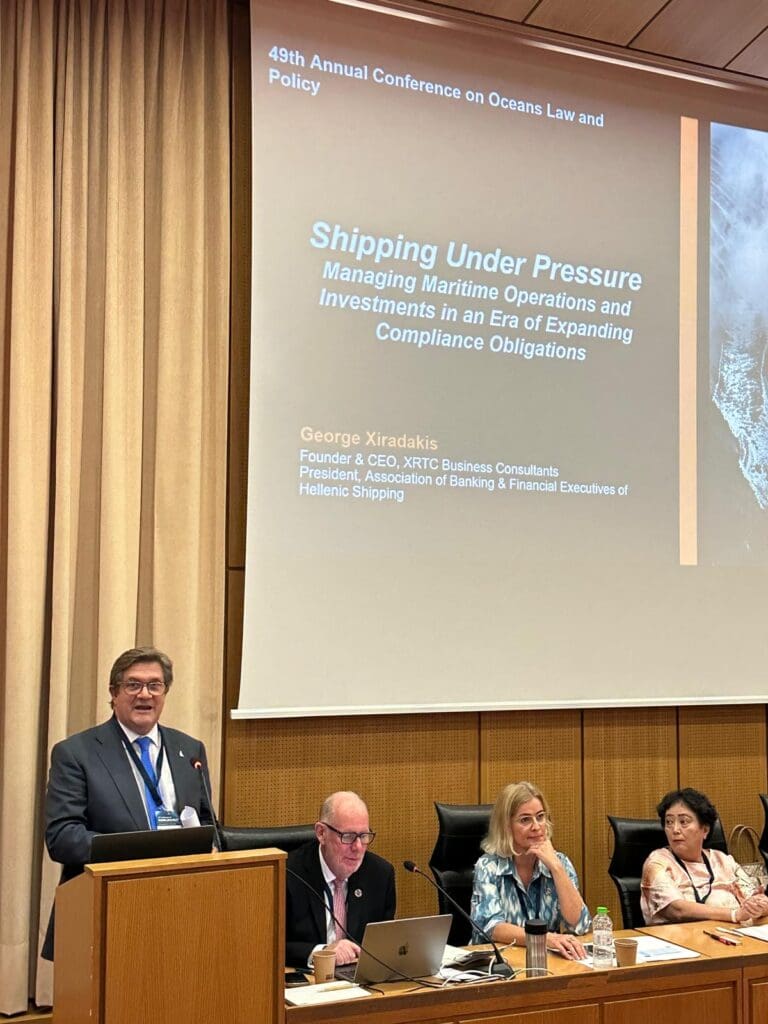
He therefore called for banks and shipowners to be treated as partners in the compliance process. Financial institutions require reliable, timely and standardised information, while shipowners need regulatory certainty and financing structures that recognise the long investment cycles of shipping.
Referring to the central role of the International Maritime Organization, Mr Xiradakis stressed that global shipping requires clear, consistent and globally implemented rules. Although regional initiatives may pursue legitimate objectives, regulatory fragmentation increases uncertainty, operating costs and investment risk. He called for closer coordination among the IMO, governments, regional institutions, financial institutions and the shipping industry, supported by realistic implementation periods, harmonised reporting requirements and a clear understanding of how ships and shipping finance operate in practice.
Concluding his intervention, Mr Xiradakis stated: “A regulation that cannot be implemented effectively or financed sustainably may satisfy a legal requirement on paper, but it will not necessarily make shipping safer.” He emphasised that maritime security and regulatory compliance are shared responsibilities among the IMO, governments, shipowners, banks, charterers, cargo interests and insurers. The operational, compliance and financial burden cannot be placed exclusively on the shipowner—and certainly not on the seafarer.

