





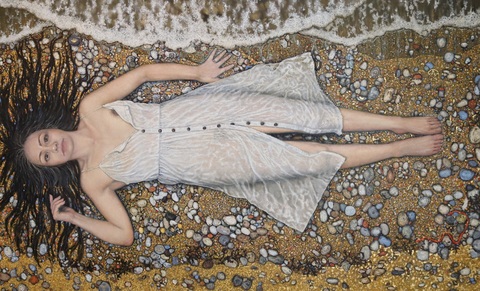
Sandancer. By Steven Wood.
Muses, music and more in the frame at Royal Society of Portrait Painters 2020 show
By James Brewer
In a dreamlike shoreline vista, a clear-eyed young woman clad in diaphanous white reclines against a background of pebbled sand.
Her affecting reverie is envisioned in an oil painting that is among the prize winners in the Royal Society of Portrait Painters Annual Exhibition 2020 at the Mall Galleries in London. The painting’s romantic title Sandancer distils the psyche of the contemplative belle whose gown might be a 21st century echo of the drapery favoured by the Renaissance master Botticelli.
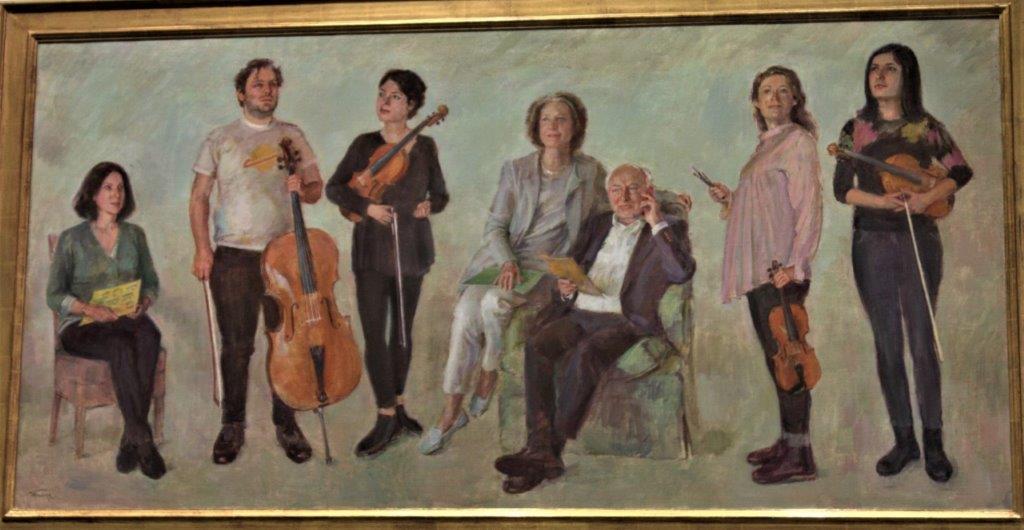
The Marryat Players. By June Mendoza.
It is not widely known, but the term Sandancer is used to describe people from the town of South Shields, which is at the mouth of the River Tyne. The origin of the name is disputed, although some people think it refers to the sand historically excavated for glassmaking in the northeast of England.
The exhibition is a gold seam of 200 stunning pictures – chosen from nearly 2,500 submissions – mainly by established artists. The number of submissions is growing year on year. In an era when art practitioners refuse to be repressed by financial strictures or pandemic, it is a testament to the life force of modern portraiture, which the society has sought to foster since its foundation in 1891.
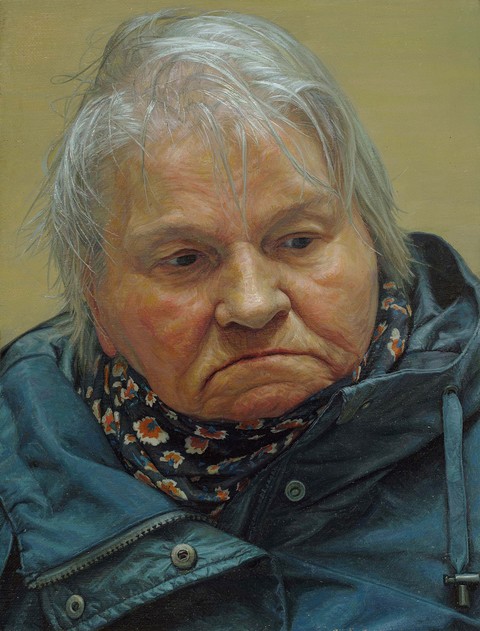
Woman in a Stadtische Galerie. By Shuang Liu.
Self-taught artist Steven Wood, who lives in Essex, took as his muse for the portrait the pensive Julie Kassim. The almost fairy-tale setting is at base prosaic: French Bay, one of the beaches of South Shields, a community once humming with shipbuilding and heavy industrial activities but now priding itself on its marine parks and other resort and cultural attractions. The inlet cove was an entrepôt for smugglers and is said to have been named after a French ship that ran aground in the 17th century.
With her dark hair splayed out in the direction of three sides of the frame, Julie’s slim figure hovers just above the pebbly beach and is about to be lapped gently by the tide whose froth mirrors the wavy inlay of her garment.
Describing the work, Steven wrote: “Scattered around the painting are [motifs] symbolic of runes that represent her spirituality and beliefs in the supernatural and white magic. The image is placed in landscape form giving the viewer a sense of floating above her.” Steven added gold and silver leaf “which to her represents prosperity and abundance.”
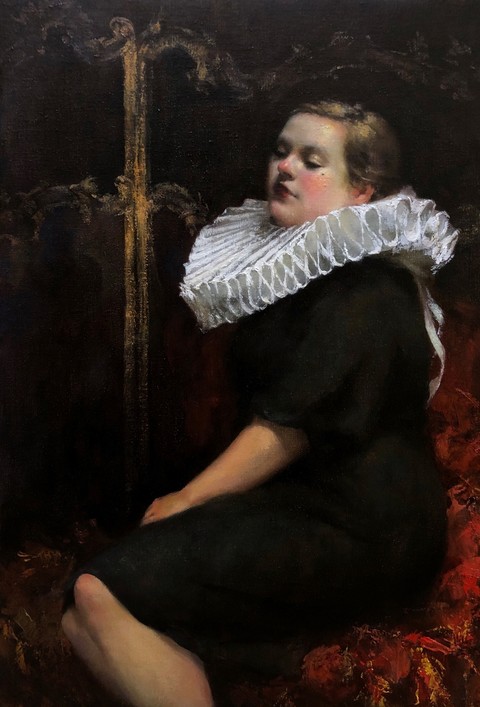
Lily Before the Play. By Nneka Uzoigwe.
For this mesmerising artwork he was awarded the Smallwood Prize for contextual portraiture given by the London architectural practice Smallwood, founded in 1976.
Behind each portrait on show is a story of human endeavour or fortitude, or both, depicted in many styles including stark bodily reality of the Lucian Freud kind.
One of the most life-affirming of this panorama of riches is a large (76 x 153 cm) canvas picturing seven musicians posing informally for the nonagenarian artist June Mendoza. The musicians are members of The Marryat Players and the viewer sees immediately that this is a remarkable family, dedicated to their professions and harmonious in every way.
Established in 2000 in the front room of her home in Wimbledon Village by music teacher Margaret Lewisohn (fourth from left in the picture), the ensemble began as a small group of string players. With her husband Oscar (shown seated) they host the Marryat Players Orchestra for Young Musicians which gives concerts at nearby King’s College School, Wimbledon, and the Marryat Players Chamber Music Festival at the family home.
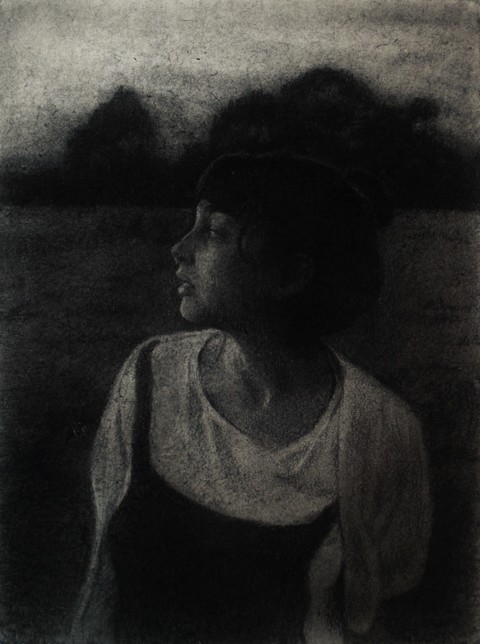
Walkie Talkie. By Jack Freeman.
From left to right in the portrait are Anita Lewisohn, Bartholomew LaFollette, Jenny Lewisohn, Margaret Lewisohn, Oscar Lewisohn, Sophie Lewisohn, and Louisa Clogston.
Jenny is the couple’s daughter and a professional violist (jennylewisohn.co.uk) She was a founder member of the orchestra and co-founder of the Chamber Music Festival. She is married to cellist Bartholomew LaFollette who is the artistic director of the Chamber Music Festival (bartholomew-lafollette.com)
Sophie, another daughter, was a founder member of the orchestra and now works as an artist in Amsterdam (sophielewisohnart.com) – hence the brushes at the ready.
Anita is Oscar’s daughter and manages the Marryat Players Orchestra for Young Musicians. Louisa is her daughter who plays in the orchestra, is reading music at Cambridge, and helps with front of house at the Chamber Music Festival.
June Mendoza, who is a member of the Friends of the Marryat Players, says: “”When the extensive Lewisohn family agreed to sit (stand!) for me [in 2019], they suggested five; but seven turned up; eight, if you count Sophie’s bump.” The “bump” is Sophie’s son Adam who is now seven months old.

Dame Glynis Breakwell. By Joshua Waterhouse.
Margaret Lewisohn told us: “If the canvas had been even bigger there would have been several other members of the family included! Not seen are Sophie’s husband Omri Epstein, pianist of the Busch Trio who have performed at the Chamber Music Festival. Omri has performed as a soloist with the orchestra. Anita’s husband Al Clogston is a jazz pianist and together with their son Ben Clogston (jazz saxophone) they play at the parties after the concerts. And so it goes on!”
The chamber orchestra repertoire ranges from Bach to Piazzolla and includes five compositions written specially for it. The Marryat Players have worked with soloists including Nicola Benedetti, Alina Ibragimova and Piers Lane.
Of her composition, June Mendoza wrote: “Balancing body shapes and colour blocks via the separate figures and instruments, I decided to do them as if in a frieze.”
Born in Melbourne in 1924 to professional musicians, June painted her first portrait when aged 13, studied for two years at Saint Martins and acted in the West End, in film and on television. June has lived in the Far East and Australia and is settled in London. Her subjects have included the Queen and Queen Mother and other senior members of the royal family, politicians, musicians, and actors.
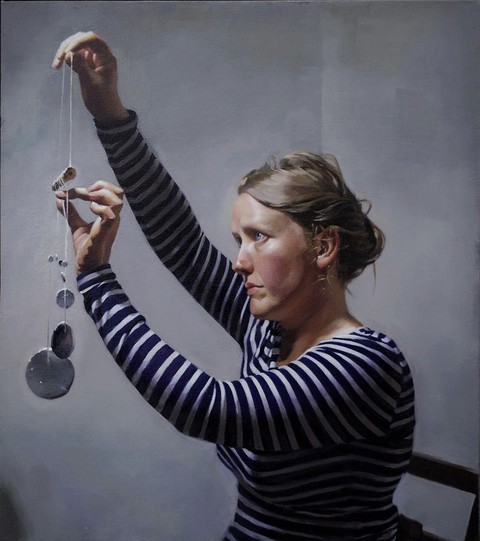
The Most Important Thing in the World. By Stephen Leho.
The £10,000 Ondaatje Prize for Portraiture and the Society’s Gold Medal is awarded for the most distinguished portrait of the year, and for 2020 has been scooped by Shuang Liu for his strikingly lifelike Woman in a Stadtische Galerie. The prize is sponsored by philanthropist, stockbroker and former Olympic bobsled competitor Sir Christopher Ondaatje and the Ondaatje Foundation.
Born in Shanghai, the artist won first place in the joint examination of the city’s art colleges and universities and was admitted to the Academy of Fine Arts of Shanghai University, receiving a master’s degree. His figurative portraits have featured in numerous national and international exhibitions including the Portrait Society of America’s International Portrait Competition.
In a statement he said: “The work uses traditional European techniques to detail an elderly woman who lived in Germany during World War II. The work expresses the sitter’s inherent persistent spirit and conveys the vicissitudes of time. The dress is a reflection of contemporary tradition.”
Mafalda von Hessen. By Massimiliano Pironti.
London-based Nneka Uzoigwe won the de Laszlo Foundation Award for Lily Before the Play, a portrait in oil from life of “the wonderful model Lily Holder prepared to go on stage.” Lily describes herself as “a life model. found both in front of and behind the easel.
The de Laszlo Archive Trust honours the memory of Philip Alexius de László, (1869 Budapest – 1937 London), who portrayed members of imperial families and other leading personalities. The trust has donated to the National Portrait Gallery in London more than 15,000 items of correspondence and press cuttings kept by de László.
In a career change, Nneka started training several years ago at London Fine Art Studios, where she is now a tutor. She received de Laszlo scholarships which allowed her to continue learning and realise her dream of becoming a full-time artist. She is inspired by the work of 19th century Italian master Antonio Mancini and British painter Solomon J Solomon (1860-1927). Nneka said she sets out “to create a narrative while working from what I see with my imagination.”
The Prince of Wales’s Award for Portrait Drawing has gone to Jack Freeman for a charcoal entry, Walkie Talkie. In a statement he said: “I made this drawing of Patricia after a walk through Grantchester near Cambridge. The evening light made the scene particularly poignant. I wanted to capture the feeling of a walk, late in the day, through countryside, and I think the smokey blackness of the charcoal – particularly as it works into this hand-made paper—gives the picture a grainy sentimentality.” Since gaining a BA (Hons) degree in fine art at Falmouth University, Jack has been living and working between Cambridge and Essex.
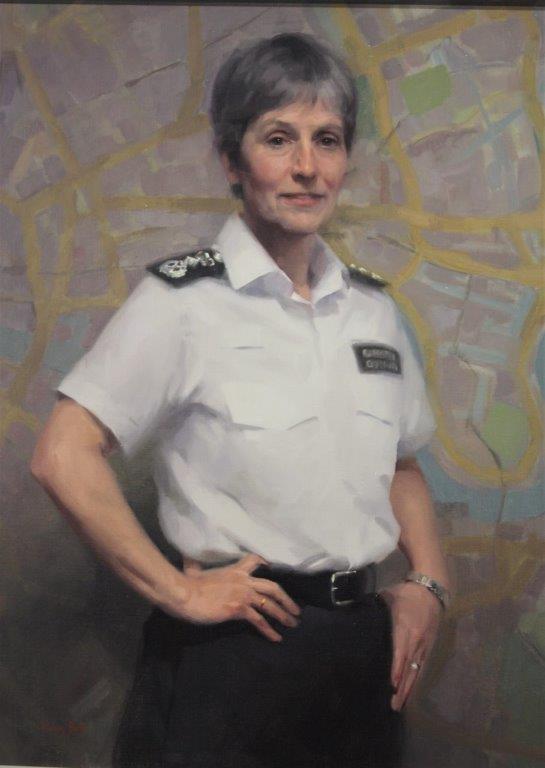
Cressida Dick. By Frances Bell.
Controversy has surrounded the sitter of one of the prize-winning paintings, Dame Glynis Breakwell. For the exhibition, Joshua Waterhouse submitted a study for a large painting of the academic, who resigned in 2018 from the leadership of Bath University after 17 years. Her departure from the top role followed criticism of her allegedly excessive pay package, which had made her the country’s highest-paid vice-chancellor but which she defended as justified.
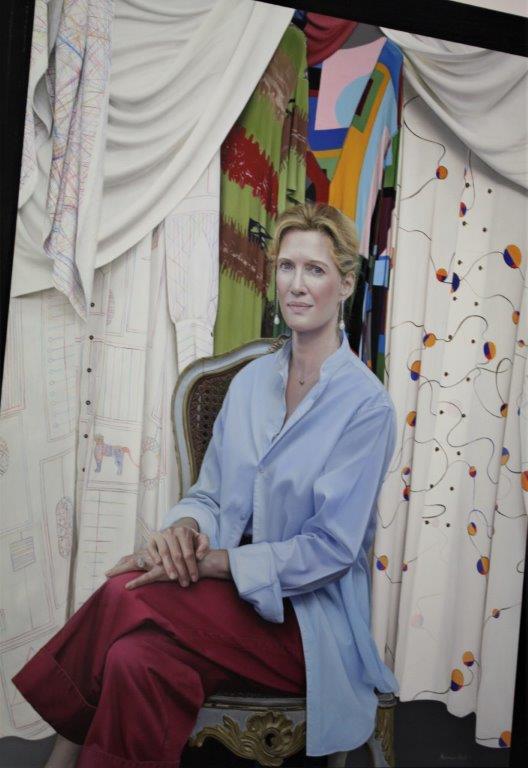
The study was selected by the exhibition panel of judges for the Burke’s Peerage Foundation Award for classically inspired portraiture. The much larger painting of Dame Glynis was commissioned by the university. In the smaller size, the exhibited work hints at some of the finer details in the larger portrait including the upholstery but is dominated by a yellow background. The larger painting shows the vice-chancellor in her living room sitting on an ornately embroidered chair surrounded by objects which tell the story of her career.
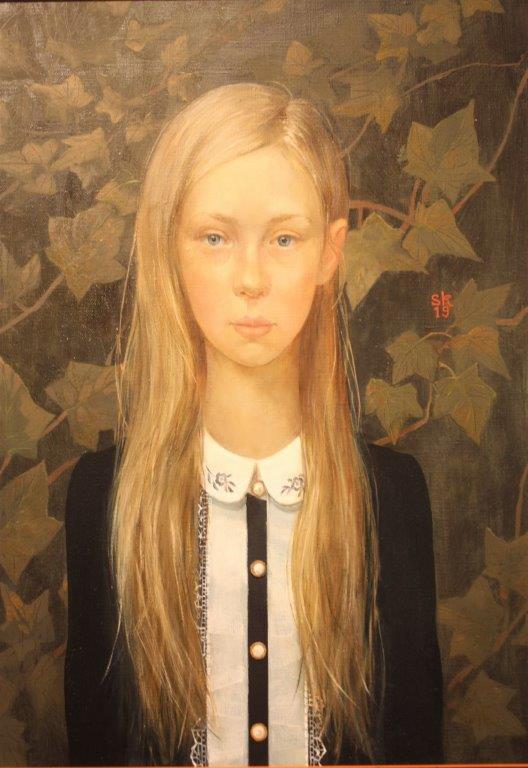
Beginning. By Svetlana Kornilova.
Joshua, who describes himself as a hyperrealist artist, lives and works in east London, painting in oil on well prepared wood panels, and says that he draws much of his inspiration “from artists of the Northern Renaissance while producing work with a contemporary feel.”
The Royal Society of Portrait Painters Award went to Stephen Leho for The Most Important Thing in the World. In this, the sitter holds a small mobile she made, which represents the solar system. She is straightening the threads. “The painting is about mental health and emphasises the need to stay in the present,” said Stephen. “Stripes on the jumper represents the shift between positive and negative emotions.” Stephen, who is based in the Welsh capital, studied at Cardiff University, Gloucestershire University and at the Facultad de Bellas Artes, Seville under the Erasmus scheme. After graduation he travelled mainland Europe as a street artist.
Fashion designer Mafalda von Hessen (Princess Mafalda of Hesse) is herself the subject of attention in a luscious portrait by Italian actor, singer, dancer, and painter Massimiliano Pironti, who was invited to exhibit by Alastair Adams, a past president of the society.
One of several high-profile sitters, Metropolitan police commissioner Cressida Dick exudes calm and confidence in an oil painting by the prolific Frances Bell.
Other familiar faces include the former judge Sir Brian Leveson who chaired the 2011 public inquiry investigating the culture, practices and ethics of the press, portrayed by Mark Roscoe; the politician Lord Hattersley by Benjamin Sullivan; film producer Lord Puttnam by Hero Johnson; and a principal dancer with the Royal Ballet, Ed Watson, by Fiona Graham-Mackay.
Beginning, an oil by Svetlana Kornilova of a demure young girl, brings a different tradition, influenced by Russian genres, to the show. Svetlana graduated from Stroganov Moscow State University of Industrial and Applied Arts in 2014 and took an advanced course at the famed Repin Saint Petersburg Institute of Painting, Sculpture and Architecture. Since a first exhibition in 2009, she has won several awards.
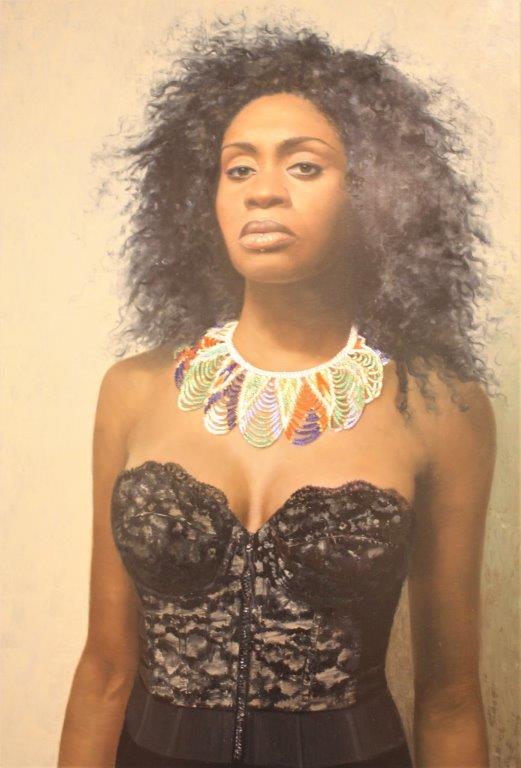
Lioness. By Shana Levenson.
Svetlana has said: “Most of all I love to paint people. Because the matter is not only in form and colour, everything is much more interesting because of the internal content, the psychological and mental layers of the models… a picture is not just an image, but my way of telling a story or a fairy tale.”
The strength of the courageous and independent woman shines out clearly in the oil painting Lioness by Shana Levenson, who works in Albuquerque, New Mexico. Shana pursued a BA in fashion design at the University of Texas and after the birth of her children, an MFA from the Academy of Art University, San Francisco.
Much praise is due to Annabel Elton, head of commissions for the society, and her colleagues for managing the exhibition in the challenging circumstances of 2020 afflicting everyone in the arts sector.
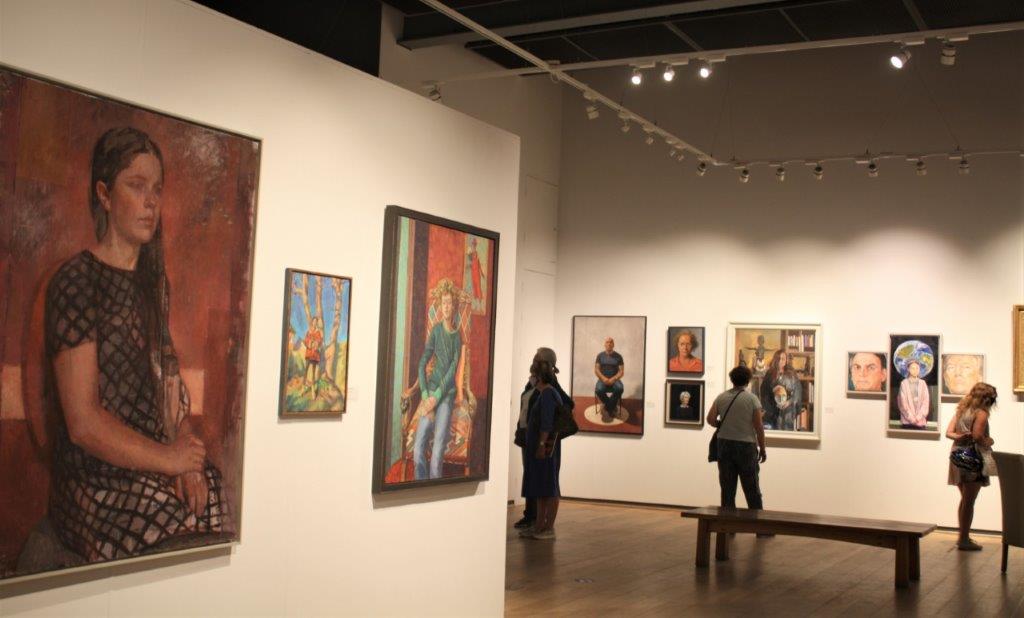
Spaced out at the Mall Galleries.
The exhibition is open at Mall Galleries until Saturday 26 September. It had to forgo a private view because of Covid-19 restrictions, but the way the society has managed its timed entry and social-distancing policy has caused the minimum of inconvenience to visitors. It is open from 11am to 5pm. Entry is £5, and free for under 25s and Friends of Mall Galleries. Timed tickets are bookable at www.mallgalleries.org.uk Many of the works are available to view at www.therp.co.uk
