





By James Brewer
“When things go wrong, they go wrong in a big way,” and this underlines the critical importance of safety throughout the maritime field, says Karen Davis, managing director of the Oil Companies International Marine Forum (OCIMF). The prospect of adapting ships to meet the decarbonisation agenda is bringing safety even more sharply into focus.
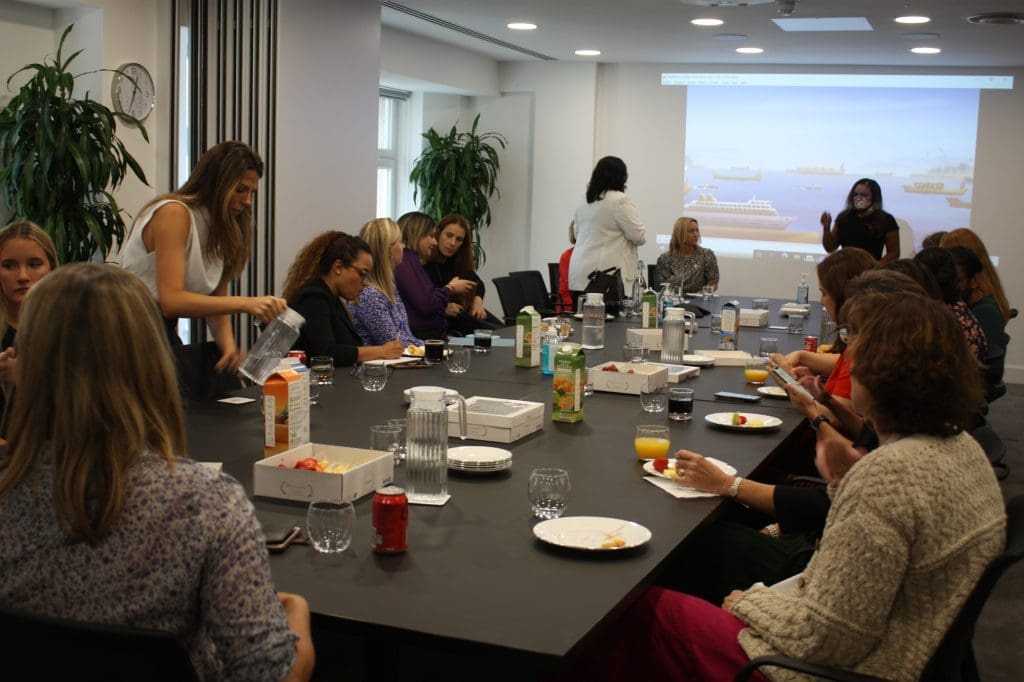
Capt Davis joined Sarah White, Shell Shipping and Maritime’s health, safety, security and environment manager, for a presentation to an audience of 40 members and friends of WISTA UK. Under the title Future Fuels and Safety, the seminar, on August 31, 2022, was hosted by the major insurer Gard (UK) at its London office.
“There is so much technology and so much noise,” commented one of those present at the meeting, about the ongoing intense debate as to how shipping should set its fuel course.

Capt Davis said that the global fleet was increasing year by year, already at more than 60,000 ocean-going vessels – 2.1bn dwt of capacity. Transporting close to 80% of world trade by volume, the fleet is estimated to contribute up to 3% of greenhouse gas emissions. This posed the need for modern methods of propulsion to reduce emissions from fossil fuel era.
After an overview of alternative fuels favoured by various top shipowners and experts, she cautioned: “There is no one great solution. They all have their complexities.” She added later, during the question-and-answer session with audience members: “I think there will be a time when we have to have hybrid vessels.”
Maritime industry stakeholders faced the dilemma of taking newbuild investment decisions when there were still competing analyses of what was the most efficient and economical mode to follow, as technology marched forward.
Many owners have already started investing heavily in methods they think will have environmental traction – and Capt Davis warned that fundamentally “we need to be careful to build safety into the system.”
A graph was displayed reflecting scepticism that the International Maritime Organization target for total greenhouse gas emissions from shipping to be slashed to half 2008 levels before 2050 will be met. Projections indicate that the industry’s progress with alternative fuels, energy sources and design, technical and operational measures, will be inadequate to meet such a reduction in carbon intensity.
Further, new hazards might change the risk to the industry. Human factors must be considered from design to implementation by engaging with all industry stakeholders.
Capt Davis said that OCIMF seeks to promote the safe and environmentally responsible transport of crude oil, oil products, petrochemicals and gas by developing best practices in the design, construction and safe operation of tankers, barges and offshore vessels and their interfaces with terminals. OCIMF has consultative status at the IMO.
Ms Waite said her job was to reinforce Shell’s “commitment to improving its sustainability and environmental awareness.” At the company she is responsible for the safe operation of 30 managed vessels and the ships of some 500 contracted parties.
She told the WISTA meeting that before she entered the maritime industry eleven years ago, she had given little thought to the seaborne logistics needed to deliver goods ordered online to the domestic customer. “I was completely ignorant of just how dangerous it is. Those eleven years have really opened my eyes to the dangers it can take ‘to get that Amazon parcel to my door.’”
Often, disasters happened through no-one’s fault. As a global industry, shipping had progressed in leaps and bounds and “we are much further advanced than we were 20, 30, 50 years ago,” but a UK study had shown that “our seafarers are five times more likely to be in a serious accident than people working in construction. We also know that suicide is a big issue in our industry: including unexplained deaths, people are 15 times more likely in our industry to be involved than anywhere else. That worries me and makes me sad.”
Complementing her role at Shell, Ms Waite is programme manager for Together in Safety, an initiative which came out of a meeting in Singapore in October 2019, for industry to come together to improve safety performance as one. It is working on assessing the operational risks and the competence requirements for the safe handling of future fuels. “Safety has to start from the leaders,” declared Ms Waite.
She stressed the importance of “sharing our learning and sharing our data,” although companies were reluctant for competitive reasons to share data.
The Together in Safety forum had managed to narrow down to 14 areas key incidents that are causing the biggest number of accidents. “If we could solve just five of these 14 areas, we know it would make a huge difference.” Among critical issues, attention must be focused on wellbeing and care: life at sea and when people are not at sea.
An overview of the pros and cons of individual fuels described by the speakers, and by the Safety of Future Fuels Report produced for the Together in Safety programme, emerged.
The report was based on a series of hazard identification workshops which considered LNG, methanol, ammonia and hydrogen. It said that these fuels would demand significant changes to ship design, port infrastructure, and supply chain operations. As the fuels were likely to be available at scale for deep sea shipping applications within the early 2030’s, action was required now to ensure the industry was ready for their safe introduction.
LNG, the most prominent part of the alternative fuel market, has been used as a fuel for two decades.
Liquid hydrogen has long been used by the American space programme as rocket fuel to deliver crew and cargo including in the main engine of the Space Shuttle. Hydrogen requires energy-intensive processes for its production, at present mainly from coal or natural gas; and it has significant flammability. It is a low energy density fuel which on board ship would need fuel storage tanks, limiting cargo carrying capacity.
Unlike LNG and methanol, there are no international regulations covering the design and operation of hydrogen-powered vessels. Ammonia is another fuel that lacks a regulatory framework.
An increasing number of shipowners have placed orders for dual fuel newbuilds using methanol which could be served by existing bunkering infrastructure and storage in line with IMO and class regulations. But methanol has a flash point below 60C, which requires additional fire prevention measures for storage and handling.
Of other mooted solutions, the problem with ammonia is its toxicity; batteries take up much space on a ship; and cold ironing (providing electrical power to a berthed ship from a shoreside power point) uses a huge amount of energy – and needs matching facilities at other ports. Governments meanwhile are worried about the effect on ports and their hinterlands of decarbonising ships.
Questions at the meeting included whether anyone was looking at the full vessel life cycle. Capt Davis said there is work being done on the whole value chain and the life cycle.
The expected competition between shipping and other industries for fuel availability was raised, as was the pressure for “green corridor” maritime routes. Should all ships be dual-fuelled, or should it depend on where they are trading?
The OCIMF leader underlined the challenge in the current uncertainties of future fuel and technology of building a new ship. “The vessel life is 20, sometimes 30 years. There is such a huge investment for the shipowner who is waiting on the new technology.”
Capt Davis took up her current post on moving from US-based ConocoPhillips at the end of 2021. She had spent 15 years at sea, becoming one of the first female master mariners and commanding very large crude carriers, petroleum products and chemical tankers.
The event was opened by Jucilla Walters, an executive committee member of WISTA UK, and moderated by the UK association’s president Monica Kohli.
