





Dear Maritime Community:
The past few months have witnessed much handwringing about the emissions reporting requirements expected by IMO and the related uncertainty. This was affirmed at the recent MEPC meeting where it was agreed that CII needed more work in order to be valuable, practical and universal.
The SHIPPINGInsight SHOWCASE held on December 13th illuminated the challenges facing the industry in reporting emissions for global validation, while profiling the solution being offered by SHIPNEXT called SCII. One of the questions posed by a participant revolved around EEOI. SHIPNEXT Founder and CEO, Alexander Varvarenko, promised to address EEOI, and has done so:
“EEOI is the only realistic approach proposed by IMO but has a lot of technical and procedural obstacles to execution and implementation. To calculate it, internationally, across the whole industry for all the 87.000+ commercial vessels, the industry would need to have hundreds of thousands of people involved just performing the routine, similar but repetitive, calculations and reporting. SHIPNEXT launched a solution, an algorithm, that does it instantly on top of its Freight-matching TMS (shipping platform), that helps determine and compare the best shipping solutions, or ways of employing the vessel, and optimize the decision-making on basis of all the thousands of different criteria and factors. And, as you know, it works for dry-bulk, breakbulk, and wet-bulk fleet already.
Here is a very detailed explanation and analysis on the calculation of EEOI:
https://www.seacargocharter.org/wp-content/uploads/2020/10/UCL-2015-Understanding-the-Energy-Efficiency-Operational-Indicator-Main.pdf
In the end, it all boils down to this formula (see attached below):
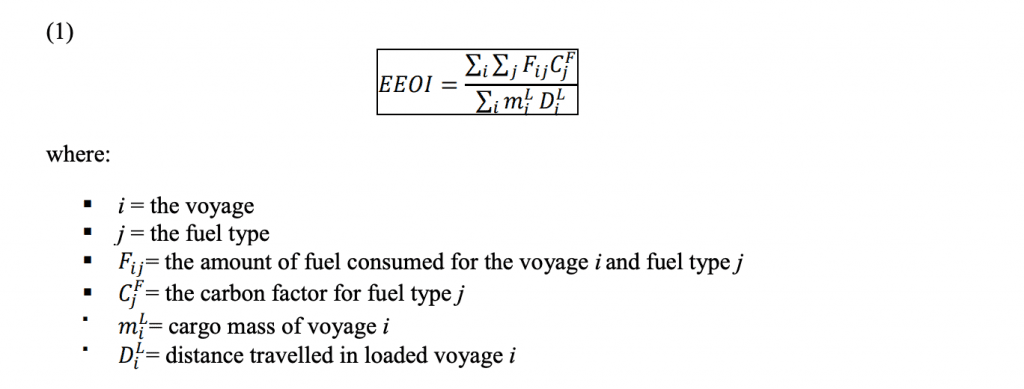
- In EEOI, the result (total CO2 produced) is divided by total “cargo mass” and “distance,” so expressed in tons “per mt per mile,” which is a very-very small figure, whereas Shipnext does not divide it by the distance traveled, and its expressed in “per mt.” This is debatable, and we can change the formula in 1 hour. The result is still the same. The consumption of fuel and the duration of the voyage is taken into consideration in both cases.
- EEOI is and can be expressed over a certain period of time. Whereas SCII is calculated, for an understandable reason, for each leg. Simply because Shipnext allows it to be done in just 1 click/1 second for as many vessels/voyages/cargo the user likes. There is no need to do all the manual work of accumulating documents, proof, bills, statements, charter parties, and calculations to hand in the report after a certain period of time.”
To see the replay of the December 13th SHIPPINGInsight SHOWCASE, go to https://www.shippinginsight.com/showcase/
