





By James Brewer
On first looking upon ancient Greek ruins in Sicily, the 19th-century Austrian artist Ferdinand Georg Waldmüller saw the light: the gorgeous auras that suffused the island, leading him to bring new verve to his interpretations of the romantic Vienna Woods close to his home.
Waldmüller (1793–1865) was struck especially by the environs of the temple of Juno (or Hera Lacinia) which was built around 450 BC in the Valley of the Temples at Agrigento, and of the 3rd-century BC Greek theatre at Taormina, with its dramatic views of Mount Etna and the coast.
As well as landscapes, Waldmüller painted portraits, genre pictures and still life. In the first UK exhibition of his paintings, Waldmüller: Landscapes(until September 20, 2026), the National Gallery collaborates with the Belvedere Museum of Vienna. Waldmüller revelled in the heyday of landscape painting across Europe , capturing the public’s yearning to luxuriate in the natural world. His scrupulous details of trees, scenes from the Vienna Woods, and views of the Salzkammergut, an idyllic Alpine region, suited a prevailing public mood.

The modest but engaging exhibition in the UK capital comprises 14 works, mostly from the collection of the Belvedere, with other loans from the Liechtenstein Collection and the Vienna Museum.
Waldmüller’s views of Sicily were painted during autumn visits from 1844 to 1846 to the Mediterranean island. They celebrate the artist’s favoured elements of light, landscape and classical ruins.
One can understand how the temple Juno Lacinia took away his breath. Majestically spread on a mountain crest, it offers sweeping vistas of the Mediterranean and draws visitors for its golden sunsets. At one stage wrongly attributed to the Roman goddess Juno (Lacinia), the sacred site was dedicated to Hera, the Greek goddess of marriage and childbirth.
The structure with its classic Doric columns has on its eastern side the remains of a huge ten-step altar for sacrifices. A reddish hue to many of the stones is thought to have resulted from a Carthaginian assault on the city in 406 BC.

For his painting, Waldmüller strategically silhouetted the temple against a pale blue sky. His graceful brushstrokes followed the contours of the terrain from a fan palm in the foreground to grey-green foliage along the escarpment.
At the Teatro Antico di Taormina, Waldmüller gloried in the views of Etna, with its fiery potential, over the Ionian Sea. He pictured the volcano in the background with a plume of smoke emerging from the peak. From in front of the tiered seating he exploits the contrast between the ruins flooded in glowing sunlight and the intense blue sea. With dainty realism, he lovingly paints the edifice’s honey-coloured bricks flung around by destructive forces, so that the spirit of nature soothes the turbulence of time.
Waldmüller thrived in Austria’s Biedermeier era, which stretched from the end of the Napoleonic Wars to the1848 uprisings against the Habsburg monarchy and other elites. In between those cataclysms a growing middle class was lulled by trends in music, theatre and art, with paintings not of conflict but focusing on family life, domestic furniture and leisure. (The appellation Biedermeier surfaced years later, named after the satirical character “Papa Biedermeier,” who personified the self-satisfied, middle-class citizen.)

Waldmüller served such tastes copiously and his paintings are coloured by visions of ease; but exhibition co-curator Sarah Herring cautions: “While Waldmüller is considered a Biedermeier artist his work, along with other artists of the period, can be both moralising and unflinchingly honest.”
Such realism appeared when his genre scenes interacted with rural life. Waldmüller believed that the revered study of nature was the foundation of painting, as did contemporaries on the wider European plain, such as John Constable and Jean-Baptiste Camille Corot.
As elegantly as setting words to music, the Austrian put nature under meticulous inspection, from the slender tree trunks and their branches and leaves , to views of meadows and lakes.
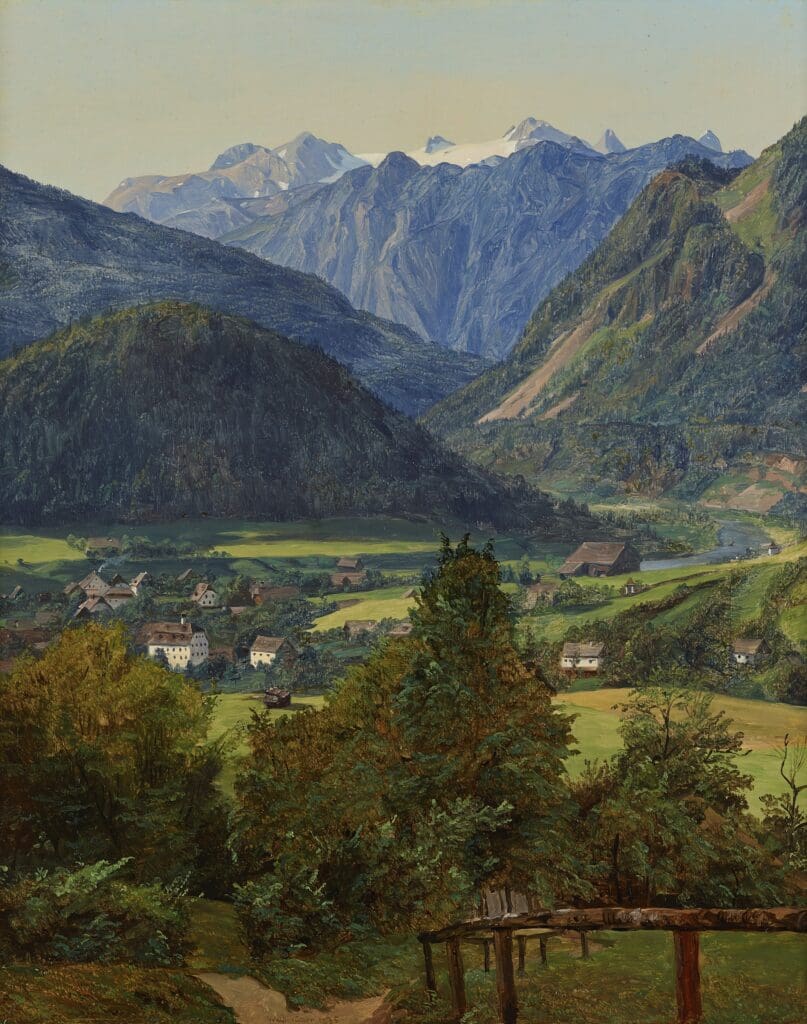
He was a marvel at conveying a sense of distance: just to the south of Salzburg, he pictured the Dachstein Glacier which rises 2,700 meters above sea level. That painting has a role too as a salutary souvenir, as since Waldmüller‘s day the glacier has retreated to the extent that organised skiing is impossible during the summer.
Entering the Academy in Vienna in 1807, Waldmüller supplemented its traditional education by teaching himself landscape painting through copying Dutch 17th-century examples, particularly those of Jacob van Ruisdael and Meindert Hobbema,
From landscapes of the Prater, a Vienna amusement park that was once a royal hunting ground, the National Gallery exhibition shows how the artist aligned with the move throughout Europe towards naturalism.
Sarah Herring clarifies: “Many of the Prater pictures focused on dead and dying branches. Such an emphasis on un-idealised nature derived in part from Dutch 17th-century landscapes, which had been copied by Waldmüller. In the 19th century the move away from the ideal and the illustrious was an element in Realism, reflected also in the adoption of ordinary men and women as subjects.”
Waldmüller began to include portraits in his landscape painting. In one instance he presented himself in a woodland setting, for good measure adding a full-blown peony at the bottom of the picture.
His attention to detail has been compared stylistically with works by Leeds-born John Wiliam Inchbold (1830–1888) and others influenced by the pre-Raphaelites. It is worth remembering that he was an influential teacher. After falling into neglect for many years after his death, he was eventually recognised by the Secession, the movement formed at the end of the 19th century by Gustav Klimt and others.

In 1856 the virtuoso took with him to London 34 works, all of which sold. One each was bought by Queen Victoria and Prince Albert after a private audience.. Waldmuller would have had an opportunity to see pre-Raphaelite paintings at the Royal Academy, but he and developed his approach independently.
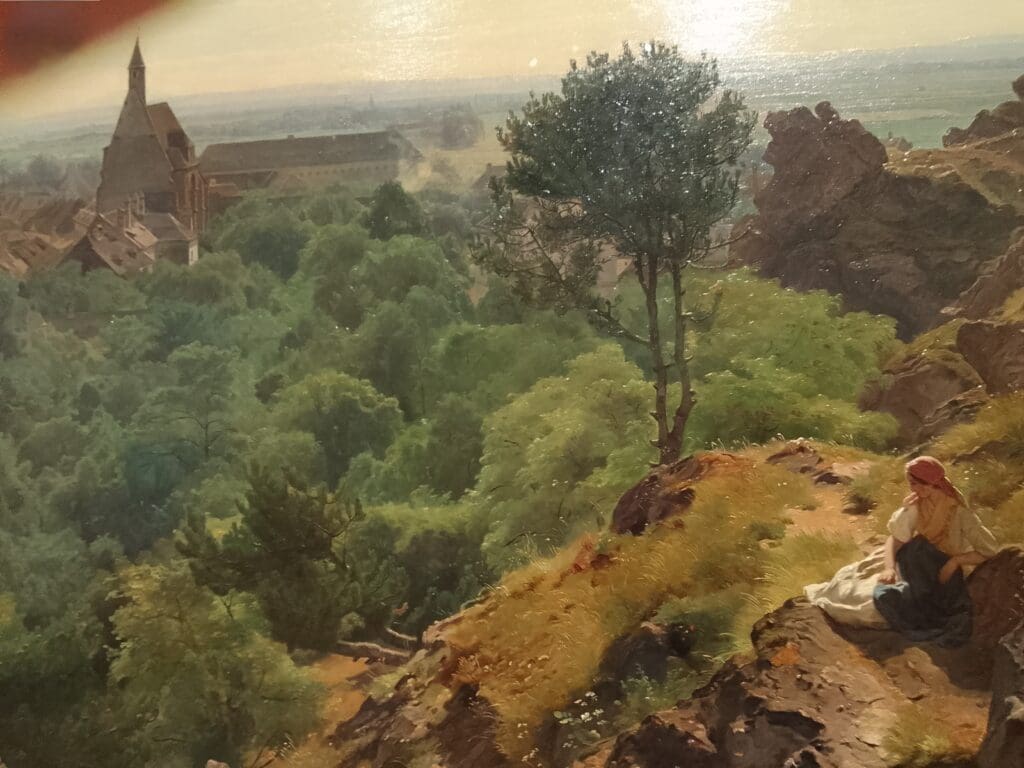
That his treatment of light in his late paintings was informed by his experience of the intense sunlight of Sicily can be seen in his 1848 view of the town of Mödling, which is 15 km south of Vienna amid the rolling hills of the Vienna Woods and the region’s flourishing viticulture. He chose a viewpoint where a mass of trees overlooks the town, dominated by the Spitalskirche (hospital church).
Artists and musicians including Beethoven, Schubert and Schönberg were familiar with Mödling. Attributed to Beethoven are the Mödlinger Tänze a set of waltzes, minuets and ländler; and in the town the Beethoven Memorial Museum commemorates the great man.
In 1823 one of the partners at the Leipzig music publishing house Breitkopf & Härtel commissioned Waldmüller to paint a portrait of Beethoven. It was the year Beethoven completed the main work on his Ninth Symphony, similarly with the Diabelli Variations and Missa Solemnis. There was only one sitting. The portrait, not in the London exhibition, is now copyright Kunsthistorisches Museum, Sammlung alter Musikinstrumente.
The London exhibition concludes with the charming Early Spring in the Vienna Woods from1861. Immersed in the joy of a spring day, a group of children gather violets as the delicate branches and the flowers portend balmier days now that the snow is melting .
Sarah Herring, associate curator of Post-1800 Paintings at the National Gallery, is joined in curating the exhibition by Dr Arnika Groenewald-Schmidt, curator of the 19th-Century Collection at the Belvedere, Vienna.
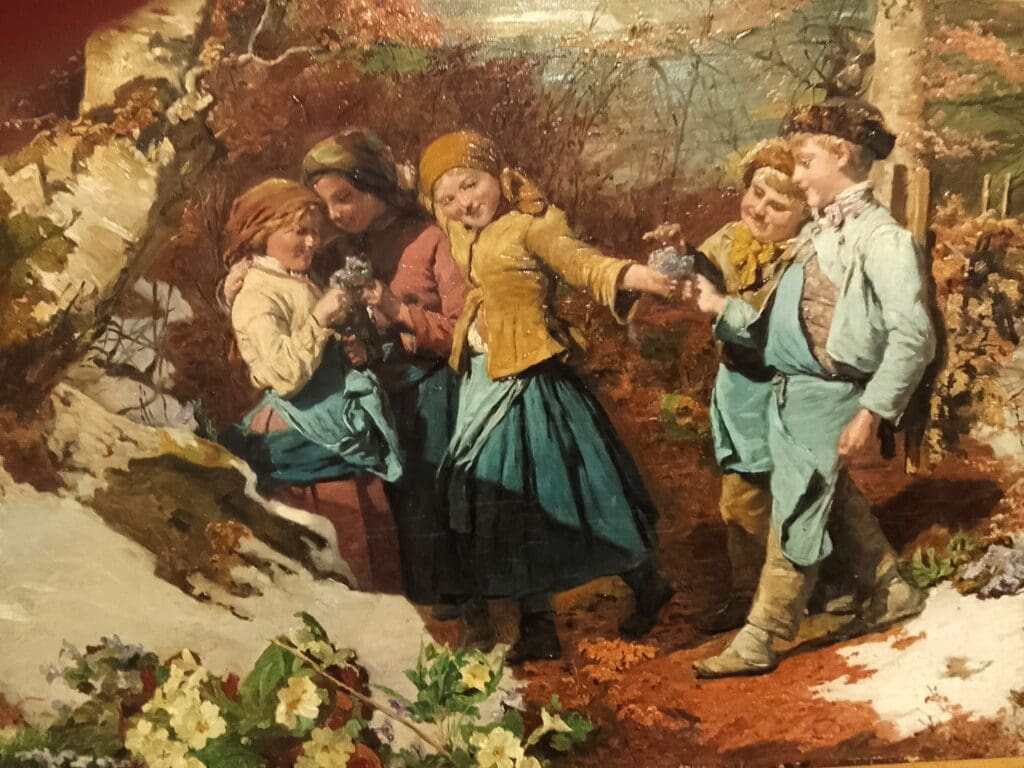
Image captions:
The ruins of the Greek theatre at Taormina, and Mount Etna, 1844. Oil on oak panel. Liechtenstein The Princely Collection Vaduz-Vienna.
Ruinen des Venustempels bei Girgenti (Hera-Lakina-Tempel in Agrigent),1845. Oil on wood. © Private Collection c/o Österreichische Galerie Belvedere.
Self-portrait as a Young Man, 1828. Oil on canvas. Belvedere, Vienna © Belvedere, Vienna.
Peony detail from self-portrait as a young man, 1828.
View of the Dachstein from the Sophien-Doppelblick near Ischl,1835. Oil on wood. © Belvedere, Vienna.
View of Mödling, 1848. Oil on canvas. Liechtenstein The princely Collection Vaduz-Vienna.
Early Spring in the Vienna Woods, 1861. Oil on wood. Belvedere, Vienna. © Belvedere, Vienna .
Early Spring in the Vienna Woods (detail), 1861.
Waldmüller: Landscapes is at the National Gallery’s Room One, until September 20, 2026. Admission free.
