






Event Report by Natalia-Lydia Papadantonaki, Dipl. Arch. Eng and AI & Computational Design Scholar University of Cambridge
The Hellenic Tech Network, under the auspices of the Embassy of Greece in London, hosted on 25 November 2025 a dedicated evening on maritime innovation and the growing role of Greece as a global hub for shipping technology companies at London’s Hellenic Centre. The event brought together investors, founders, institutional representatives and professionals active in one of the world’s most dynamic and strategically important sectors.

The evening opened with welcoming remarks by Nikol Konstantaropoulou, Legal & Policy Specialist at Lomar Labs and Member of the Board of Directors of the Hellenic Tech Network. She underlined that the current phase of technological transformation requires curiosity, bravery and vision, three qualities that increasingly characterise the new generation of maritime innovators.

Opening remarks were also delivered by Ambassador Yannis Tsaousis (pictured above), who highlighted Greece’s longstanding identity as a nation of the sea and its centuries-old leadership in global shipping. He referred to the growing ecosystem of research institutions and maritime technology startups developing solutions for real-time analytics, vessel optimisation and AI-enabled operational management. He noted that Greek maritime startups are now scaling internationally, supported by investors and stakeholders who connect them with shipowners; a dynamic that reinforces Greece’s position as a leader in the evolving maritime technology landscape.

The keynote was delivered by Prof. Dr. Haris Lambropoulos, President of the Hellenic Development Bank of Investments (HDBI) and Member of the Boards of the European Investment Bank and the European Investment Fund.
Prof. Lambropoulos presented the evolution of Greece’s equity investment ecosystem and the significant expansion of available venture capital instruments. HDBI now manages more than €1 billion across multiple funds, supporting innovation, digital transition, sustainability and next-generation technologies.
He emphasised the strategic importance of the maritime sector for Greece, noting that the country remains the world’s leading shipping nation. He referred extensively to HDBI’s investment footprint and the role of equity financing in accelerating new technologies with strong scaling potential. He highlighted that the impact of artificial intelligence marks a clear turning point, describing a fast-approaching distinction between “before AI and after AI” in maritime operations and investment strategy.
Panel I – Greece’s Investment Edge in the Maritime Tech Ecosystem
Moderator: Ioanna Saranti (Senior Associate, DLA Piper)
Speakers:
Nikos Petrakakos (Managing Director, Tufton Investment Management)
Argyris Stasinakis (Inventor, Entrepreneur, Founder, Maritime Innovation Network)
Lucy Partner (ETF Partners)
Prof. Haris Lambropoulos (HDBI)
The first panel examined how investors identify value in maritime technology and what makes Greece an increasingly attractive environment for venture capital.
Lucy Partner referred to the decision to invest in Greek AI-enabled sustainability ventures, noting that environmental and emission-reduction technologies present strong market pull and clear regulatory momentum.
Nikos Petrakakos underlined that scalability remains the decisive factor in investment decisions, noting that investors primarily assess whether a technology can grow globally and whether the founding team demonstrates the competence and cohesion required to deliver that scale. He pointed out that investors distinguish shipping operations from maritime innovation: “We do not invest because we are shipowners; we invest because the idea makes sense.”
Argyris Stasinakis highlighted the importance of visibility, global reach and data access. He described the maritime sector as fragmented and stressed the need for structures that connect founders with shipowners to validate ideas, gather real-world data and accelerate adoption. Cybersecurity was also identified as an emerging priority area.
Prof. Lambropoulos added that HDBI has already channelled significant resources into maritime-related technologies and that the sector offers opportunities of considerable magnitude. He referred to existing co-investment mechanisms and to the ability of funds to support larger-scale initiatives when required.

Panel II – Disrupting the Waves: Startup Founders Transforming Maritime Sustainability
Moderator: Stylianos Papageorgiou (Managing Director, Lomar Labs)
Speakers:
▪ Leon Grillet, Co-Founder & CEO, BlueNose Technologies
▪ Manos Koukouvios, COO, Vsltec
▪ Dr Minas Liarokapis, Founder & CEO/CTO, Acumino
▪ Alexandros Papageorgiou, CFA, CFO, HarborLab
The second panel brought together founders working on real-time analytics, vessel performance optimisation, robotics and digital platforms for maritime operations.
Leon Grillet noted that London offers strategic advantages for networking and access to capital, explaining that his company secured nearly 70% of its funding through international channels. He emphasised that founders need to demonstrate tangible progress before approaching investors.
Manos Koukouvios commented on the convergence of traditional shipowning families with newer generations educated abroad, a combination that broadens the industry’s openness to innovation. He described the commercial process as demanding, noting that each client engagement “is a battle”, yet Greece is well positioned to leverage its European networks and long maritime heritage.
Alexandros Papageorgiou discussed the industry’s family-oriented structure and how this influences decision-making and adoption cycles. He noted that scaling a maritime startup requires a focused offering targeting a clearly defined segment.
Dr Minas Liarokapis brought the perspective of an academic transitioning into entrepreneurship, emphasizing that Greece has a strong reservoir of young engineers with exceptional intelligence and technical skills. He noted that Greek graduates can advance rapidly in innovation-driven environments, making local talent a strategic choice for maritime technology companies. While Greece did not participate in earlier industrial revolutions due to the absence of heavy industry, he stressed that the AI-driven shift is fully accessible to a small nation – as it relies not on physical production, but on knowledge and code. This creates a unique opportunity for Greece to align its maritime heritage with emerging technological capabilities, turning this convergence into a key competitive asset.

Greece’s Broader Maritime Innovation Landscape
Throughout the event, speakers referred to Greece’s long-standing maritime identity and to the increasing potential for the country to assume a leading role in key areas of technological development. Discussions touched on AI-enabled vessel optimisation and predictive analytics, the growing use of robotics and automation, digital platforms that support port and fleet operations, and sustainability-focused technologies. Participants also emphasised the importance of digital tools that integrate real-time operational data into decision-making processes, underlining how such innovations are reshaping modern maritime workflows. Greek maritime startups are increasingly scaling internationally, supported by new investment mechanisms, venture capital initiatives and institutional collaborations. Investors and stakeholders highlighted the importance of connecting founders with shipowners to validate solutions and accelerate global adoption. The evening concluded with a networking reception, providing an opportunity for further discussion among participants, founders and industry representatives.
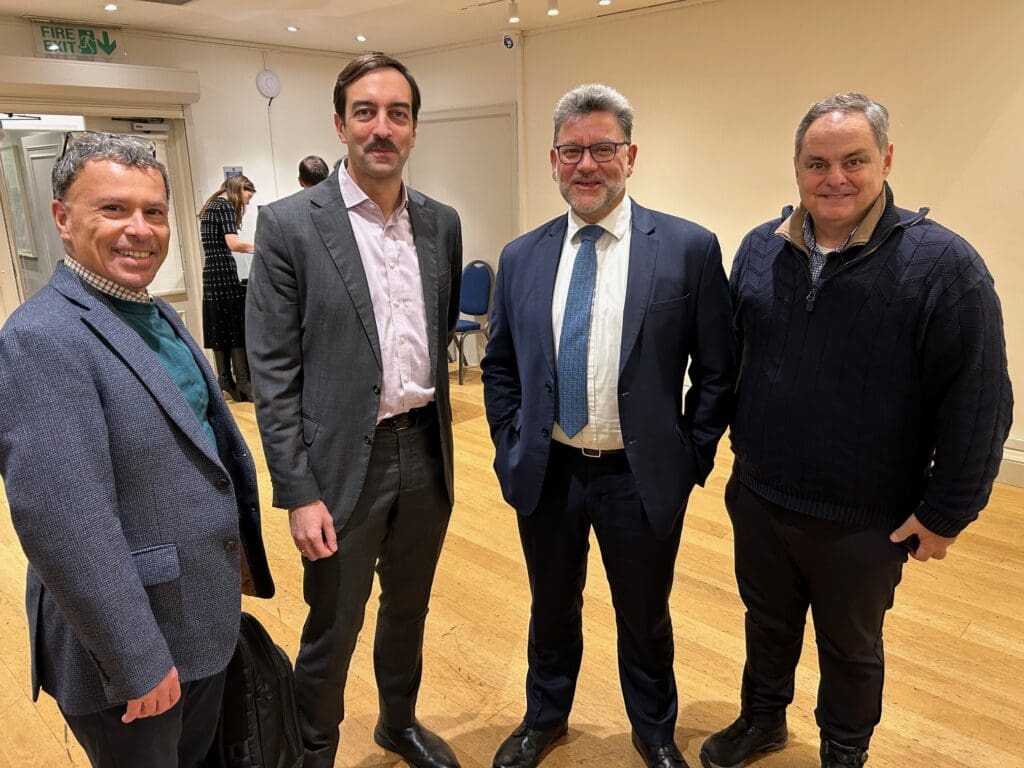
Interestingly the Greek Shipping Industry was there in full force with the majority at the audience being members of the Hellenic Engineers Society of Great Britain (HESGB) headed by its president Dimitris N. Monioudis as well as few speakers (see picture above).
