





Brief Update: No 09-1/2026 Date: May 29, 2026
Executive summary
- This document has been approved for distribution by SEA GUARDIAN S.G. Ltd / Intelligence & Analysis Department. The provided Information and Intelligence derives from open sources, the Institute for the Study of War (ISW), the Joint Maritime Information Center (JMIC) and the United Kingdom Maritime Trade Operations (UKMTO) respective Web Pages. Additional products retrofit the company’s Strategic/Operational and Security situational awareness process for threat and risk assessment impacting Maritime Security in different areas. All rights reserved, “no part of this risk assessment may be reproduced in any form (electronic, mechanical, paper, or other means) without written permission by SEA GUARDIAN S.G. Ltd, which maintains the rights for personal data of the document writers”. Under no circumstances can SEA GUARDIAN S.G. Ltd be held responsible for any loss or damage caused by a reader’s reliance on information obtained by this assessment, especially on its firms, company’s management, or individual decision-making.
Objectives
- To provide the maritime industry and Security Stake or Shareholders in a monthly cycle, with:
- Major maritime security incident summary and analysis in Geo-strategic frame for Operational Security and Security of shipping for the period April 30 to May 29, 2026.
- Assessment updates concerning military operations – terrorism – piracy and cargo theft, hijacking and detentions, smuggling, stowaways, ships fired, crew losses and Cyber-threats, covering a wide spectrum of threats/risks from Maritime Security to Navigational Safety.
- SEA GUARDIAN, pursues innovative approach by analyzing Maritime Security in accordance with international standards and a certain frame of Geo-policy, including synergies with a subject matter expert (SME) entity for Cyber-defense including the most important sectors of policy, methods and training to mitigate cyber threats and risks.
- Important notes:
1. The Assessment is produced by the R&I team in a global approach covering 23 different regions in total, either offering to readers the opportunity to study it as a whole, or focusing on areas of interest through the context table.
- You can navigate directly to:
[MARITIME SECURITY INCIDENTS] or [ASSESSMENT’s SECTIONS CONTEXT TABLE]
Recent Key Developments (RESUME + LINK TO..)
April 30
- It was stated that direct negotiations between Lebanon and Israel continue. Hezbollah has intensified threats and incitement against the Lebanese government and President Joseph Aoun. The group rejects state decisions on talks with Israel and the issue of Hezbollah’s disarmament, openly challenging the government authority. Lebanese leaders are being accused of treason and compared to figures such as the Vichy France leadership and Anwar Sadat, raising fears of political violence and a possible civil conflict.
May 01
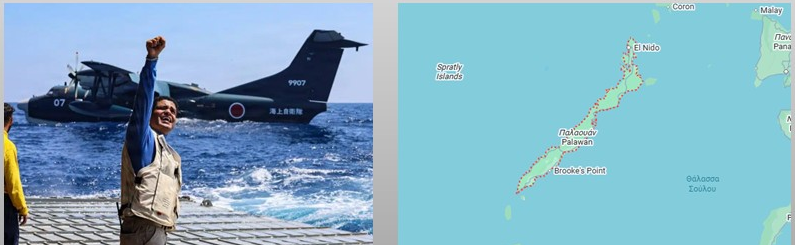
- Japan’s US-2 amphibious aircraft made its first appearance in Balikatan 2026, the largest joint military drills between the Philippines and the United States. The aircraft took part in a casualty evacuation drill near Palawan in the South China Sea. Japan also deployed 1,400 personnel, warships, transport aircraft, and missiles – its first full participation and first combat troop deployment to the Philippines since World War II – highlighting a stronger regional defense cooperation amid tensions with China.
May 07
- The National Resistance forces in Yemen announced the killing of Houthi commander, Abdu Jiash, in a targeted operation in Al-Jarahi district, south of Hodeidah. The strike, carried out by Joint Forces on the western coast, also destroyed military vehicles and equipment. Jiash was accused of leading attacks on civilians and committing abuses against local tribes in the region.
May 08
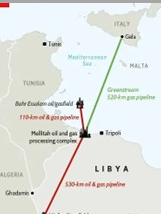
- A delegation of Italian lawmakers visited Libya to explore increasing gas imports to Italy amid energy shortages caused by the Gulf war. Attention is focused on the Greenstream pipeline, which could supply more Libyan gas to Italy, considering that production has been limited by Libya’s instability since 2011. Italian officials and energy company ENI are now considering infrastructure upgrades to boost gas flows in the coming months.
- a large share of world trade and oil. While the U.S. strengthens its presence in the region, it seems tensions are rising as China seeks alternative routes to reduce reliance on the Strait. Indonesia has also discussed possible transit fees, highlighting the strait’s growing geopolitical importance.
May 09
It was stated that the Strait of Malacca is a crucial global shipping route carrying
- Israel said it will release two activists, Thiago Ávila and Saif Abu Keshek, who were detained after joining a Gaza-bound flotilla, will be transferred to immigration authorities for deportation. The activists were taken off the Global Sumud Flotilla by the Israeli Navy in international waters. Israel accuses them of links to a group it says is connected to Hamas, while rights group Adalah said they were part of a humanitarian mission to challenge the Gaza blockade. All the other activists from the flotilla were released and transported to Crete-Greece in order be repatriated. released in Greece.
May 10
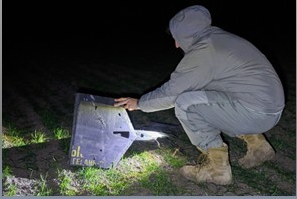
- Ukraine proposed sending security experts to Baltic countries after multiple drone incidents near NATO borders. Estonia confirmed talks are underway to improve coordination and prevent drones from entering neighboring airspace. Recent drone crashes in Latvia, Lithuania, and Estonia raised regional security concerns. Ukraine denied sending drones intentionally into NATO countries and suggested Russia may be redirecting them to create instability and propaganda opportunities.
May 11
- A U.S. Navy ballistic missile submarine, believed to be the USS Alaska, made a rare visit to Gibraltar during heightened tensions involving Iran and negotiations over reopening the Strait of Hormuz. The submarine’s appearance was seen as a strategic show of U.S. military strength and support for NATO allies. The visit came as talks between the U.S. and Iran remained strained, with Donald Trump rejecting Iran’s latest proposal related to ending hostilities and reopening the strait.
- Taiwan and Japan are increasing cooperation on drones through industry partnerships focused on supply chains, development, and testing. Japan aims to boost domestic drone production by 2030 and is turning to Taiwan for key components. Most collaboration is happening through private companies and industry groups rather than governments.
May 12
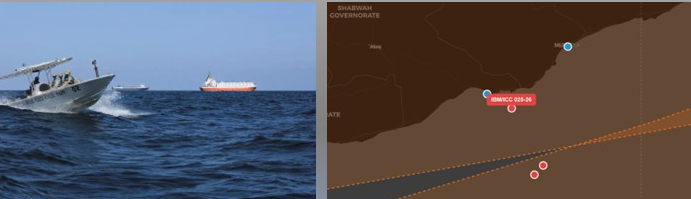
- “Qatar condemned the hijacking of an oil tanker in Yemeni waters carrying Egyptian sailors, calling it a violation of international law and a threat to maritime security. The tanker was reportedly taken to waters near Puntland by pirates. Egypt confirmed that eight Egyptian sailors were aboard the vessel, while reports said pirates are demanding a ransom for their release. Qatar expressed support for Egypt and urged international cooperation to protect shipping routes and secure the crew’s safe release. The incident reflects the renewed rise of Somali piracy since late 2023 after years of decline.
May 13
- Estonia says it is ready to respond strongly to any Russian military or hybrid threat by increasing defence spending, ammunition reserves, cyber capabilities, and cooperation with NATO allies. Estonian leaders believe the war in Ukraine has shown that countries bordering Russia must be prepared for a rapid escalation. Estonia is also focusing on closer military cooperation with partners such as Poland, Finland, and the United Kingdom, especially improving the rapid movement of allied forces across the Baltic region during a crisis.
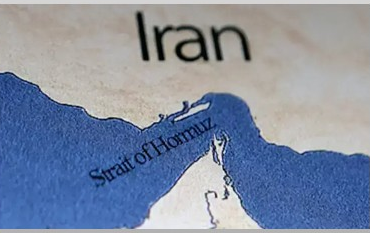
- A Chinese supertanker carrying about 2 million barrels of Iraqi crude has passed through the Strait of Hormuz after being stuck in the Gulf for over two months due to the Iran–U.S. conflict and is now anchored near the Gulf of Oman. The ship’s movement comes amid rising tensions in the region and ongoing diplomatic activity involving the U.S., China, and Iran. It is one of several recent Chinese-linked vessels navigating the strait since the conflict began. The tanker is owned by COSCO-related entities and chartered by a Sinopec trading arm, and is headed to Asia.
May 14
- The Philippines President held an emergency meeting after political tensions escalated, following gunfire at the Senate building. The incident came as Senator Ronald “Bato” dela Rosa, who faces ICC-related charges tied to the drug war, was reportedly taking refuge there amid fears of arrest. The shooting caused panic and a heavy security response, including police, armed guards and Marines, while protests also broke out outside the Senate.
May 15
- The Panama Maritime Authority (PMA) has responded to an “unprecedented” rise in Chinese detentions of its ships with a commitment to double down on safety standards. In a statement sent to Trade Winds, the PMA outlined measures being taken to reduce the rate at which vessels are being held in Chinese ports.
May 16
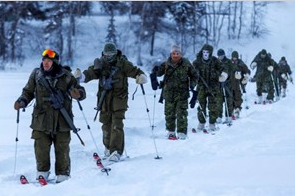
Greenland and Denmark are working with Canada to develop a Rangers-style Arctic force amid rising security concerns, including U.S. threats to seize Greenland and the growing Russian activity in the region. Canada’s Arctic Rangers already operate in remote areas, and Nordic countries are now looking to replicate that model. The cooperation reflects a broader shift toward tighter Canada–Nordic defense ties and reduced reliance on the United States for Arctic security.
May 17
- Egypt and Eritrea said that only Red Sea coastal countries should control security in the region and rejected outside involvement. Their statement comes amid tensions with Ethiopia over its efforts to gain Red Sea access through Somaliland. Egypt, Eritrea, and Somalia are coordinating against Ethiopia’s maritime plans, while Egypt and Ethiopia also remain in dispute over Nile River waters. The two countries also discussed increasing trade, investment, and economic cooperation.
- Reports say Iran has deployed military personnel linked to the Islamic Revolutionary Guard Corps near the Bab el-Mandeb Strait in western Yemen amid rising tensions with the United States. Yemeni sources claim the deployment includes Quds Force members and foreign fighters arriving through unofficial ports in Hodeidah, raising concerns about increased maritime threats in the region.
May 18
- The Chinese ambassador defended China–Guyana relations, highlighting major investments, infrastructure, healthcare, and cultural exchanges, while rejecting U.S. claims of “Chinese influence.” It is a diplomatic message promoting China’s role in Guyana and countering U.S. criticism amid broader geopolitical competition.
May 19
- Saarbrücken has suspended its official partnership with Tbilisi over concerns about Georgia’s political direction, including restrictions on protests, media, and opposition groups. The city says it will maintain cultural and civil ties while ending official contacts with Tbilisi’s current leadership, including Mayor Kakha Kaladze.
- Tourism leaders warned that the Iran war and Strait of Hormuz crisis could raise fuel prices and reduce flights this summer, causing delays and higher ticket costs. Travel is already being affected, but officials hope the situation will improve if the conflict eases.
May 20
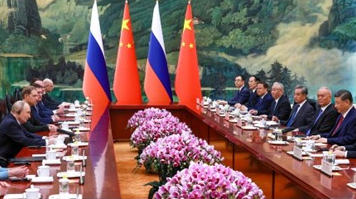
- Russia and China criticized growing U.S. and NATO military activity in the Arctic, calling for the region to remain peaceful and stable. After recent talks between Vladimir Putin and Xi Jinping in Beijing, both countries also opposed sanctions and foreign interference, supported counterterrorism cooperation with Afghanistan, condemned strikes on Iran, and backed a Gaza ceasefire and a two-state solution for Palestine.
May 21
- Europe’s economy is weakening because the Iran war has pushed energy prices higher, increasing inflation and slowing business activity. Governments are offering limited financial support, while the European Central Bank faces difficult decisions on interest rates amid rising recession fears.
May 22
- US says Cuba is a national security threat and unlikely to reach a peaceful deal. It has indicted former president Raúl Castro over a 1996 plane shootdown. Cuba denies the claims and says the US is lying. Tensions between the two countries are rising, with diplomacy looking unlikely.
- The arrest of alleged Albanian trafficker Ervin Mata in Brazil highlights the major role Balkan criminal networks play in Latin America’s cocaine trade. These groups help connect South American suppliers with European buyers. while also handling logistics and money laundering operations.
May 24
- Russia launched a major overnight attack on Ukraine with 600 drones and 90 missiles, mainly targeting Kyiv. Ukrainian officials said at least four people were killed and 83 injured. Most drones and missiles were intercepted, but several sites, including homes and schools, were damaged. President Volodymyr Zelenskyy called the attack severe and urged stronger international support for Ukraine.
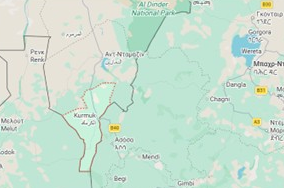
- The Sudanese army said it captured the Al-Baraka area near Al-Kurmuk in Blue Nile state after clashes with the RSF and allied SPLM-N fighters. The army claimed it secured the area and destroyed or seized military equipment, while the RSF has not commented. The fighting is part of Sudan’s ongoing civil war, which has caused a major humanitarian crisis since 2023.
May 25
- Nigeria’s Civil Defense Corps sealed branches of Inner Galaxy Steel Company and Jiuxing Integrity Industrial Ltd over alleged terrorism financing and theft of railway infrastructure. Authorities said stolen government materials were recycled into commercial products, and the companies have not yet responded to summonses.
- It was stated that Iran is considering an “environmental tax” on ships passing through the Strait of Hormuz as part of a maritime framework with Oman. Instead of directly blocking shipping, Iran may use legal and administrative fees to gain economic leverage over global trade routes. Analysts warn that if accepted internationally, similar charges could spread to other main global maritime chokepoints, increasing long-term global shipping and energy costs.
May 27
- Syria and the Organization for the Prohibition of Chemical Weapons say dozens of undeclared chemical weapons linked to the former regime of Bashar al-Assad were found at several sites in Syria. Authorities said the materials have been secured for destruction while investigations are ongoing.
- Israel said it killed Mohammed Odeh, the new head of Hamas’s armed wing in Gaza, in a strike on Tuesday May 26. The same day, Israeli strikes in southern Lebanon reportedly killed 31 people, according to Lebanese authorities, amid continuing clashes involving Hezbollah and Hamas-linked targets.
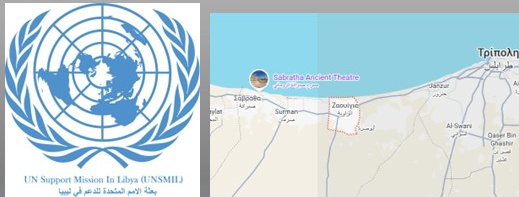
- United Nations Support Mission in Libya expressed concern over escalating militia mobilization and assassinations in Zawiya, warning that the violence could trigger further instability and endanger civilians. The mission called for restraint, investigations into unlawful killings, and renewed dialogue ahead of Eid al-Adha, while reaffirming support for efforts to restore stability in Libya.
[return to Objectives]
MARITIME SECURITY INCIDENTS: April 30- May 29, 2026 1
| INCIDENT No – TYPE | INCIDENT TIME | INCIDENT DETAILS | ||
| UKMTO WARNING – 048-26 – SUSPICIOUS ACTIVITY | 01 May 2026 | Coordinates 13.054833, 48.736000 UKMTO has received a report of an incident within the IRTC, 92NM southwest of Al Mukalla, Yemen. The Master of bulk carrier has reported being approached by a skiff with a black hull carrying seven armed persons. Vessels are advised to transit with caution and report any suspicious activity to UKMTO while authorities continue to investigate. | ||
| IMB/ICC 025-26 – HIJACKING | 02 May 2026 | Coordinates 13.816667, 48.466667 0500 UTC. Around 12nm South of Qana Port Terminal, Shabwa, Yemen. Nine-armed persons boarded, hijacked, and took hostage the crew on an anchored tanker. Reports indicate the tanker to be heading towards the Somali Coast. Local and international Authorities are investigating. | ||
| UKMTO WARNING – 049-26 – SUSPICIOUS ACTIVITY | 02 May 2026 | Coordinates 13.159000, 48.839833 UKMTO has received a report of a suspicious approach 84NM southwest of Al Mukalla, Yemen. The Master of a bulk carrier has reported being approached to within 500 meters by 1 green hulled skiff which was accompanied by 1 white fishing vessel. Vessels are advised to transit with caution and report any suspicious activity to UKMTO while authorities continue to investigate. | ||
| UKMTO WARNING-050-26 – ATTACK | 03 May 2026 | Coordinates 26.517667, 56.885667 UKMTO has received a report of an incident 11NM west of Sirik, Iran. The Master of a northbound bulk carrier has reported being attacked by multiple small craft. All crew reported safe and no environmental impact reported. Vessels are advised to transit with caution and report any suspicious activity to UKMTO, while authorities investigate. | ||
| UKMTO ADVISORY – 051-26 – SUSPICIOUS ACTIVITY | 03 May 2026 | Coordinates 25.867333, 55.917333 UKMTO has received a report from several Masters in the vicinity of Ras Al Khaimah, UAE, that they have been directed via VHF broadcast to move from their anchorages. Authorities continue to investigate and vessels are requested to continue to report any further suspicious activity. | ||
| MDAT-GOG 19-26 – ROBBERY | 03 May 2026 | Coordinates 26.682500, 56.572500 On May 3, 2026, at 4:45 a.m. UTC, LAGOS Port, a Maltese-flagged cargo ship reported that eight intruders in two skiffs had boarded the vessel and stolen paint and thinner. As soon as they were spotted, the intruders fled. | ||
| UKMTO WARNING-052-26 – ATTACK | 04 May 2026 | Coordinates 26.420500, 56.606167 UKMTO has received a report of an incident 78NM north of Fujairah. United Arab Emirates. A tanker has reported being hit by unknown projectiles. All crew reported safe. No environmental impact reported. Authorities are investigating. Vessels are advised to transit with caution and report any suspicious activity to UKMTO. | ||
| UKMTO WARNING – 053-26 – SUSPICIOUS ACTIVITY | 04 May 2026 | Coordinates 25.868000, 55.289833 UKMTO has received a report of an incident 36NM north of Dubai, United Arab Emirates. The cargo vessel reported a fire in the engine room, the cause of the fire is unknown at this time. All crew are safe and accounted for. Authorities are investigating. Vessels are advised to transit with caution and report any suspicious activity to UKMTO | ||
| UKMTO WARNING – 054-26 – SUSPICIOUS ACTIVITY | 04 May 2026 | Coordinates 26.022667, 55.789333 UKMTO has received a report of an incident 14NM west of Mina Saqr, United Arab Emirates. UKMTO received information from a third party that a vessel was on fire and requesting vessels in the vicinity to keep a safe distance from them. The cause of the fire has not been verified at this time. No environmental impact reported. Authorities are investigating. Vessels are advised to transit with caution and report any suspicious activity to UKMTO. | ||
| UKMTO WARNING-055-26 – ATTACK | 05 May 2026 | Coordinates 26.617667, 56.419167 UKMTO has received a report of an incident within the Strait of Hormuz. A verified source reported a cargo vessel has been struck by an unknown projectile. Environmental impact is unknown at time of report. Vessels are advised to report any suspicious activity to UKMTO, whilst authorities investigate. | ||
| UKMTO WARNING 059-26 SUSPICIOUS ACTIVITY | 22 May 2026 | Coordinates 14.253056, 53.828333 UKMTO has received a report of an incident 98NM north of Socotra. The CSO of a tanker has confirmed that the vessel was approached by a small craft with five persons onboard. The vessels Armed Security Team fired warning shots at the small craft which forced them to alter course. Authorities are investigating. Vessels are advised to transit with caution and report any suspicious activity to UKMTO. | ||
| UKMTO WARNING 060-26 SUSPICIOUS ACTIVITY | 23 May 2026 | Coordinates 13.441667, 50.296111 UKMTO has received a report of an incident within the IRTC 200NM west of Socotra. The Master of a products tanker has reported that the vessel was approached by a small craft with 5 persons onboard, closest point of approach 100m. The vessel’s Armed Security Team were deployed and the small craft altered course away from the reporting vessel. Vessels’ are advised to transit with caution and report any suspicious activity to UKMTO whilst authorities investigate. |
| UKMTO ADVISORY 061-26 SUSPICIOUS APPROACH | 23 May 2026 | Coordinates 13.069722, 51.881111 UKMTO has received reports from various sources of suspicious activity within the Gulf of Aden. There have been multiple reports of vessels being approached by Skiff’s, a large Skiff with two outboard engines has been observed carrying both ladders and weapons. Vessels transiting the area are advised to transit with caution, follow guidance written in BMP MS and report any suspicious activity to UKMTO. Authorities are investigating. |
| SEA GUARDIAN REPORT OF WARNING – PIRACY | 25 May 2026 | Coordinates 13.550000, 50.466667 On 23 May 2026 between approximately 0215 UTC and 0325 UTC, two merchant vessels transiting within the IRTC in the vicinity of position 13°33’N 050°28’E, approximately 200NM west of Socotra, reported being approached by the same suspicious skiff with five persons onboard. The skiff reportedly approached to within 100–200 meters of the vessels and followed one vessel for approximately three minutes before departing the area after the deployment of the vessel’s Armed Security Team. While investigations into the incidents are ongoing, vessels operating in the area are strongly advised to maintain heightened vigilance, adhere to BMP-MS, and report immediately any suspicious activity or relevant information to MSCIO and UKMTO. |
| UKMTO WARNING 062-26 ATTACK | 26 May 2026 | Coordinates 23.633611, 59.655556 Incident Time: 0945UTC Source: Master UKMTO has received a report of an incident 60NM east of Muscat, Oman. The Master of a Tanker reports of an external explosion, port side aft close to the waterline. The crew and vessel are safe, although the Master reports some bunker fuel has discharged into the sea. Authorities are investigating. Vessels are advised to transit with caution and report any suspicious activity to UKMTO. |
In accordance to IMB/ICC, JMIC and/or UKMTO sources 1
The Geopolitical Profiles & International Security (G3IS)
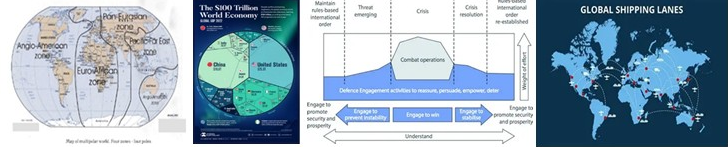
- Geo-political / Geo-Strategic profile:
- The global threats that will confront us in 2026 will be influenced more by great-power competition, geo-economics coercion, cyber-attacks, and regional conflicts than by outright warfare between major powers. Terrorism, maritime insecurity, and regional instability will still figure among the significant secondary threats, despite the reduction in shipping crime and continued cooperation in some areas.
- Geopolitical / Geo-economic Profile:
- The increased risk of geo-politics due to strategic energy chokepoints and changes in regional blocs is putting more stress on trade, even if there is potential for investments in regions like Africa, the Arctic and others. Moreover, the recent activities in Yemen, Venezuela, Guyana, and Alaska highlight the growing competition among countries in terms of securing energy sources. All in all, the trend shows that it is more about competition rather than the end of global energy.
International Security / Strategic sector:
- The situation globally in 2026 is characterized by high instability, with the outbreak of conflicts taking place via regional wars, choke points at sea, cyber activities, and proxies rather than direct military conflict between great powers. Energy and transport routes, especially in the Middle East and Red Sea region, remain the most imminent sources of confrontation, while Europe, Africa, and the Arctic are increasingly becoming vulnerable. Specific areas of potential crisis include the Strait of Hormuz, war in Ukraine, civil strife in Sudan, and hybrid activities like drone strikes and sabotage. Despite periods of calm through ceasefires and negotiations, the overall atmosphere is one of fragility and crisis vulnerability as the global system is transforming and being shaped for the next century.
Global Maritime Security / Navigational safety profile:
- Maritime security in 2026 becomes more contested and vulnerable, and the most dangerous locations include the Strait of Hormuz, the Red Sea, and other such passages where a single incident can trigger attacks, jamming, and counterattacks, leading to chaos for global shipping. While piracy levels have dropped to their lowest ever in history, naval collaboration efforts are also making some progress, although the increasing number of stowaways, illegal trafficking, shadow-fleet conflicts, and tensions near important straits, such as Bab el-Mandeb, Malacca, and the Panama Canal, indicate an expansion of threats. Somali piracy could be played as a card by third parties for geo-political reasons to cancel the Somaliland project.
[return to CONTEXT TABLE]
Cyber-Threats / Risks assessment and mitigation by CYBERPAX
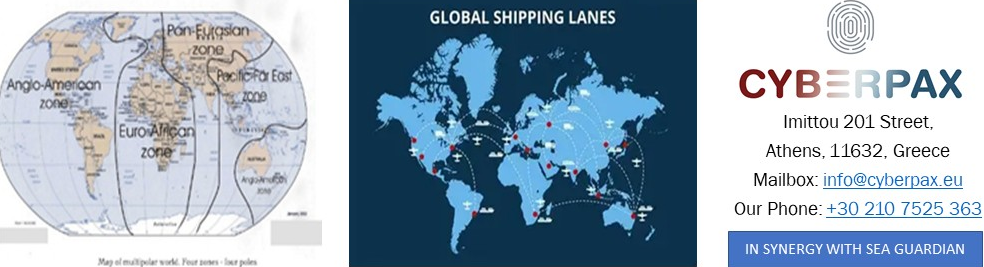
Commercial Shipping Under Hybrid Pressure: From Hormuz to the Arctic
- Recent regional developments confirm that commercial shipping is no longer exposed only to conventional disruption, but to a broader pattern of hybrid pressure affecting trade continuity, route planning and operational resilience. The current assessment material highlights severe stress around the Strait of Hormuz, including warnings over the wider economic consequences of prolonged disruption, the attack on a CMA CGM vessel in the area, and the rapid expansion of alternative logistics corridors through Saudi Arabia and Oman to keep cargo moving. At the same time, operators are facing the renewed rise of Somali piracy in the Gulf of Aden and growing strategic attention to the Arctic, where military activity and icebreaker cooperation underline that northern routes are becoming part of the wider maritime risk picture.
- For commercial shipping, the lesson is practical: resilience depends not only on ships, routes and systems, but on people who can recognise disruption early and react correctly. Whether the first signal is a suspicious cyber anomaly, degraded logistics coordination, abnormal remote access, a sudden route change, or a security incident near a chokepoint, the organisations that cope best will be those whose crews, shore teams and managers have already trained for ambiguity, escalation and continuity under pressure. In a market now shaped simultaneously by Gulf instability, piracy risk and emerging Arctic competition, training is no longer a support activity. It is part of trade resilience itself.
Two-line risk snapshot
* Hybrid disruption risk to commercial shipping across Hormuz, Gulf of Aden and emerging Arctic routes: HIGH
* Need for trained crews, shore teams and management able to detect, escalate and respond under pressure: CRITICAL
[return to CONTEXT TABLE]
THREAT ASSESSMENT UPDATE:
Libya – Central Mediterranean
- In terms of political, economic, and security affairs, there are developments in Libya that have been mixed as they are all interlinked with each other. For instance, in a sign of diplomatic and economic improvement, India has resumed its visa services in the Libyan capital, Tripoli.
- At the same time, the Italian government has stepped up its presence in Libya for the extraction of more natural gas through the Green-stream Pipeline project, even in the face of years of instability.
- Improvements in diplomatic and economic matters are, however, countered by fierce clashes between two competing militias, which led to the shutdown of an important oil refinery facility located in Zawiya.
- SEA GUARDIAN assesses that Libya will continue to be in turbulence even if there is an increase in investment for road-net, harbors and oil installations.
- Overall threat/risk level: “MEDIUM” // Analyzed in: Military/Paramilitary/Terrorism: “HIGH” – ICC/Piracy: “MEDIUM” – Hijacking/Fired/Kidnapping: “LOW” – GNSS interference: “LOW”.
- Triggers and Indicators per area remain as in SEA GUARDIAN SECURITY ASSESSMENT 25/06, April 15.
Syria (Middle East issue in East Mediterranean region)
- Syria continues to be a very risky region characterized by the convergence of both conventional and hybrid threats. The combination of military and militant activities, as well as resuming cargo shipments by Russia, maintains a highly militarized landscape and elevates the risks of possible attacks and collateral damage at critical locations.
- The increasing importance of oil shipments via newly opened border crossings puts organizations at higher risk of criminal, illicit trade, ambushes, hijackings, and other life safety incidents. In turn, the rising importance of critical infrastructure facilities and shipping routes puts them at greater risk of GNSS jamming and cyber-attack.
- Overall threat/risk level: “HIGH” // Analyzed in: Military/Paramilitary/Terrorism: “HIGH” – ICC/Piracy: “NSR” – Hijacking/Fired/Kidnapping: “MEDIUM” – GNSS interference: “MEDIUM”
- Triggers and risk indicators remain unaltered per area as initially cited in SEA GUARDIAN SECURITY ASSESSMENT 25/23, November 13.
[return to CONTEXT TABLE]
Lebanon (Middle East issue in East Mediterranean region)
- Lebanon continues to pose a very high-risk conflict area due to the combined military and criminal risks.
- The conflict between Hezbollah and Israel, along with its challenge to the government, is bound to create continuous possibilities of escalating tensions and targeted strikes, causing unintended civilian casualties. Recently the intense operations of IDF inside the territories of Lebanon escalate the threats, while the official Lebanese government can do nothing to alleviate the situation. Israel seems to pursue the total extermination of Hezbollah military capabilities targeting places assumed as weapons production installations on surface and underground.
- There are robust prospects for organized crime, smuggling, and stowaways due to the armed groups and the controversial amnesty issue. Should a dispute break out, the sophisticated abilities of both parties involved would make GNSS spoofing and cyber-attacks a serious threat.
- Overall threat/risk level: “HIGH” // Analyzed in: Military/Paramilitary/ Terrorism: “VERY HIGH” – ICC/Piracy: “NSR” Hijacking/Fired/Kidnapping: “HIGH” – GNSS interference: “HIGH”.
- Triggers and risks indicators remain unaltered per area as initially cited in SEA GUARDIAN SECURITY ASSESSMENT 25/23, November 13.
[return to CONTEXT TABLE]
Gaza-Israel (Middle East issue in East Mediterranean region)
- The Israel–Gaza maritime arena is an extreme‑risk environment across all threat axes. Military and terrorism dangers remain very high due to ongoing Israeli operations in Gaza and persistent armed confrontation with Palestinian groups, with limited warning for escalation affecting nearby sea lanes.
- Repeated interceptions of Gaza‑bound flotillas in international waters highlight a heightened hijacking/life‑safety and detention risk for politically sensitive vessels, alongside opportunities for abuse and organized criminal activity around interdictions.
- The contested, highly politicized setting also increases exposure to GNSS interference, cyber‑disruption of navigation and port systems, and secondary crime in and around ports—including profiling, arbitrary detention, and stowaway/unauthorized‑ boarding risks for ships and crews linked to the conflict narrative.
- Overall threat/risk level: “HIGH” // Analyzed in: Military/Paramilitary/Terrorism: “VERY HIGH” – ICC/Piracy: “NSR” – Hijacking/Fired/Kidnapping: “HIGH” – GNSS interference: “MEDIUM”.
- Triggers and risk indicators remain unaltered per area as initially cited in SEA GUARDIAN SECURITY ASSESSMENT 25/23, November 13.
[return to CONTEXT TABLE]
Sudan – Eritrea – Ethiopia
- The Sudan environment is highly risky with regard to drone and artillery attacks in the areas of Khartoum and other critical logistics centers, thus exposing anyone moving by either land or air transport to serious danger.
- Organized criminal activity and criminal flows have been encouraged as a result of the ongoing war, exposing anyone traveling within Sudan through the corridors towards Libya to the dangers associated to smuggling, extortion, cargo theft, and stowaway risks. On the other hand, increasing interference with GNSS and AIS makes navigation in the Red Sea risky.
- Overall threat/risk level: “MEDIUM” // Analyzed in: Military/Paramilitary/Terrorism: “HIGH” – ICC/Piracy: “NSR” – Hijacking/Fired/Kidnapping: “LOW” – GNSS interference: “LOW”.
- Triggers and risk indicators remain unaltered as cited in SEA GUARDIAN SECURITY ASSESSMENT 25/15, July 10.
[return to CONTEXT TABLE]
- Yemen and the southern Red Sea remain a fragile, escalation‑prone theatre with layered hybrid risks. Targeted strikes on Houthi commanders along the western coast confirm an active conflict zone around Hodeidah, sustaining high military/terrorism and collateral life‑safety risk along coastal routes.
- Regional competition over Red Sea security, plus Houthi alignment with Iran‑and Palestine‑ focused “resistance,” maintains a credible threat of renewed missile, drone, or harassment activity against shipping, with knock‑on exposure to organized smuggling networks, coercive boarding, and opportunistic port‑area crime, even where specific piracy or GNSS‑cyber incidents are not currently reported.
- SEA GUARDIAN had warned through its latest four months assessment that there was a possibility of a Houthi-Somalia cooperation in piracy attacks which was proven during late April and May, when hijacked ship diverted to Yemen harbors with pirates demanding ransoms to release it. It is estimated that piracy will be exploited by third actors for political reasons, and most probably to confront with the recognition of Somaliland by Israel.
- Overall threat/risk level: “MEDIUM” // Analyzed in: Military/Paramilitary/Terrorism: “HIGH” – ICC/Piracy: “MEDIUM” – Hijacking/Fired/Kidnapping: “LOW” – GNSS interference: “HIGH”.
- Triggers and risks indicators remain unaltered as in SEA GUARDIAN SECURITY ASSESSMENT 25/15, July 10.
[return to CONTEXT TABLE]
Northern Persian Gulf / Iran’s region
- The Northern Persian Gulf and Strait of Hormuz area is still very risky owing to ongoing conflicts involving Iran, and hence any military action, as well as the threat of terrorism, cannot be overlooked by shipping companies.
- High-profile statements from both the IRGC and the United States military, as well as sea mining activities in the region, put stress on the maritime community. The safety of seafarers is at high risk from activities such as missile and drone attacks, mining and maritime accidents by GNSS interference.
- Even though such activities may not be mentioned by the media, the presence of such risky elements like disputed maritime zones, economic sanctions, and valuable resources makes smuggling of goods, forced boarding, GNSS interferences, and other criminal activities likely to emerge in the case of increased US-Iran confrontation.
- Recent political actions mostly by the Iranian side, towards some kind of ceasefire, alleviate the conflict environment, even if threats and risk remain in practice amid a war situation. Shipping companies are advised to maintain high alertness, as war conditions in the terrain are high even if political movements from both actors show an intention to end the war.
- SEA GUARDIAN assesses that there is not yet a clear deadline for the end of the war.
- Overall threat/risk level: “HIGH” // Analyzed in: Military/Paramilitary/Terrorism: “HIGH” – ICC/Piracy: “NSR” – Hijacking/Fired/Kidnapping: “HIGH” – GNSS interference: “HIGH”.
- Triggers and indicators per area remain as in the SEA GUARDIAN Threat & Risk Assessment
[return to CONTEXT TABLE]
Black Sea / NW part (RUSSIA – UKRAINE WAR)
- The Black Sea region to the northwest is considered both a high-risk zone and a functional battleground due to the threats posed by adversaries in war actions, more than the acts of classical piracy.
- Ukraine uses its drones for long-range strikes against the Russian oil infrastructure, coupled with Russia’s use of the Geran-5 attack drone. These facts increase the possibility of additional attacks against oil tankers, logistical points, and the surrounding shipping with collateral damage to human lives.
- Events in northern and western strategic points of the Black Sea, such as the Bosphorus Strait, demonstrate the probability of war area expansion. GNSS interference and other cybersecurity issues remain a valid threat. In some cases, intelligence actions are associated with organized crime and paramilitary activities, while fuel thefts in ports remain secondary compared to the overall military threat.
- Overall threat/risk level: “HIGH” // Analyzed in: Military/Paramilitary/Terrorism: “VERY HIGH” – ICC/Piracy: “NSR” – Hijacking/Fired/Kidnapping: “HIGH” – GNSS interference: “MEDIUM”
- Triggers and indicators per area remain as in the SEA GUARDIAN SECURITY ASSESSMENT 25/20, September 30 and SEA GUARDIAN SECURITY ASSESSMENT 25/19, September 16 .
[return to CONTEXT TABLE]
Baltic Sea / NE part (RUSSIA-UKRAINE WAR)
- Northeastern Baltics represent a risky hybrid warfare area, with the primary threat coming from military and cyber capabilities of state actors.
- The occurrence of drone-related warnings, temporary closing of airspaces, as well as Finland joining the Ukraine-based drone coalition, indicates that UAVs can significantly disrupt air traffic and increase risks to life safety without any attacks taking place.
- Under such conditions, there are numerous incentives to engage in GPS jamming and cyberattacks on navigation and airport/port infrastructure. At the same time, piracy and organized maritime crime will be secondary forms of threat. In practice, those threats do not exist in the current period, even if Russia uses the wording of piracy for the actions of Western countries against the grey/shadow fleet, especially merchant vessels of Russian interests.
- Overall threat/risk level: “HIGH” // Analyzed in: Military/Paramilitary/Terrorism: “MEDIUM” – ICC/Piracy: “NSR” – Hijacking/Fired/Kidnapping: “MEDIUM” – GNSS interference: “HIGH”
- Triggers and indicators per area remain as in the SEA GUARDIAN SECURITY ASSESSMENT 25/20, September 30 and SEA GUARDIAN SECURITY ASSESSMENT 25/19, September 16 .
[return to CONTEXT TABLE]
Terrorism – Piracy, cargo theft, smuggling, stowaways, organized crime/drugs trafficking
- Global terrorism risk remains high, driven mainly by ongoing wars and state‑level violence in Gaza, Syria, Yemen, Sudan, and the Russia–Ukraine theatre. Airstrikes, drones, and artillery continue to threaten civilians, infrastructure, and key transport and energy nodes.
- Classic piracy has eased, but politically driven interdictions and “quasi‑hijacking” persist around chokepoints like the Strait of Hormuz, Bab el‑Mandeb, Horn of Africa, Indian Ocean and parts of the eastern Mediterranean, especially for high‑profile or sensitive vessels.
- Cargo theft, smuggling, and organized crime are entrenched along conflict and sanctions corridors—from the Gulf of Guinea to Sudan–Libya routes—triggering fuel diversion, weapons and migrant smuggling, and corruption in ports and depots, with recurring stowaway incidents on commercial ships.
- Cyber and GNSS‑related threats cut across all of this: spoofing, jamming, and manipulation of ship and aircraft tracking data in contested regions degrade navigation safety, mask military and illicit movements, and amplify the operational impact of both terrorism and organized crime on maritime trade.
- Drug trafficking, especially for shipping activities connecting South/Central America and North / Central Europe, remains high even if international agencies have achieved some results against it. It was proved that in these operations, more European citizen smugglers operate in South America under the auspices of drug trafficking dominators, imposing risks for ships and crews who, most of the time, are not involved but suffer from investigation and court procedures.
[return to CONTEXT TABLE]
Risk Assessment update:
- The Gulf of Guinea continues to be an area with medium to high risks due to various activities like piracy, kidnapping, armed robbery, and smuggling, among others. These factors, coupled with poor governance, corruption, and criminal activities, contribute to the risk level being higher, especially in Nigeria and neighboring areas.
- Recent developments in Nigeria show that there is more than just maritime insecurity; there have been kidnap raids, arrest of suspects, and navy raids on stowaways. The efforts towards securing the region are not consistent. That is why the risk level still stays at medium, with some high-risk regions.
- Overall threat/risk level: “HIGH” // Analyzed in: Military/Paramilitary/Terrorism: “MEDIUM” – ICC/Piracy: “HIGH” – Hijacking/Fired/Kidnapping: “HIGH” – GNSS interference: “LOW”
- Military threat analysis for Gulf of Guinea states:
- Triggers and indicators per area remain as in the SEA GUARDIAN SECURITY ASSESSMENT 25/20, September 30 and SEA GUARDIAN SECURITY ASSESSMENT 25/06, April 15.
[return to CONTEXT TABLE]
East Mediterranean Sea
- Regional tensions in the Eastern Mediterranean / Levant remain elevated but controlled, with visible U.S. naval deterrence reinforcing pressure on Iran and other regional actors.
- Maritime terrorism, piracy, and organized crime remain limited, with no major hijackings or life‑loss incidents reported, while GNSS/electronic interference and cyber‑related navigation risks persist at manageable levels.
- Crime in ports and stowaway cases are sporadic and localized, contributing only modestly to an overall picture of “controlled instability”.
- Overall threat/risk level: “MEDIUM” // Analyzed in: Military/Paramilitary/Terrorism: “MEDIUM” – ICC/Piracy: “NSR” – Hijacking/Fired/Kidnapping: “LOW” – GNSS interference: “MEDIUM”.
- Indicators altering the “risks levels” as in SEA GUARDIAN SECURITY ASSESSMENT 25/22, November 12, 2025.
[return to CONTEXT TABLE]
Suez Canal – Northern Red Sea
- Military/terrorism: Low, contained by strong Egyptian naval and military presence but sensitive to regional flare‑ups.
- Piracy/organized crime: Low; mainly opportunistic, near‑shore and cargo‑theft related rather than blue‑water piracy.
- Hijacking/life damages: Low overall, but consequences severe if missile/drone strikes or misidentification incidents occur.
- GNSS interference/cyber‑threats: Medium; persistent jamming/spoofing and rising cyber capabilities drive technical navigation risk.
- Crime in ports/shore: Low to medium; focused on pilferage, smuggling and petty crime, mitigated by good procedures and vetted local partners.
- Overall threat/risk level: “MEDIUM” // Analyzed in: Military/Paramilitary/Terrorism: “LOW” – ICC/Piracy: “LOW” – Hijacking/Fired/Kidnapping: “LOW” – GNSS interference: “HIGH”.
- Indicators altering the “risks levels” as initially cited in SEA GUARDIAN SECURITY ASSESSMENT 25/17, August 13.
[return to CONTEXT TABLE]
Bab-El-Mandeb Straits – Southern Rea Sea
- Terrorism/military: Low, yet uncertain; the de-escalation of hostilities in Yemen and a safe naval passage indicate that any direct threat is minimal, although the capability to conduct attacks on merchant vessels exists.
- Piracy/organized crime: Medium; frequent small-boat and boarding incidents in the Bab el Mandeb-Gulf of Aden route necessitate BMP protection and passage through the corridor. Even if there aren’t successful approaches leading to boarding yet, the likelihood of incidents has been increased remarkably, forcing shipping and maritime security companies to tighten the measures and maintain near-real-time situational awareness and intelligence.
- Hijacking / personal damage: Medium-low; no hijacking attempts have been reported recently, except for the late April beginning of May. However, one successful pirate incident may lead to hostage or injury scenario rapidly.
- Criminals in ports/stowaways: Medium; problems in Red Sea ports maintain crime risks, including extortion, corruption, and stowaways, requiring strict controls at all times.
- Overall threat/risk level: “MEDIUM” // Analyzed in: Military/Paramilitary/Terrorism: “LOW” – ICC/Piracy: “HIGH” – Hijacking/Fired/Kidnapping: “LOW” – GNSS interference: “NSR”.
- Indicators altering the “risks levels” as initially cited in SEA GUARDIAN SECURITY ASSESSMENT 25/17, August 13.
[return to CONTEXT TABLE]
Gulf of Aden – Somalia / Somaliland
- High-risk areas in relation to piracy and hijacking in Somalia/Somaliland, where there is a clear indication of a resurgence of piracy due to ransom.
- Military/Terrorism threats: Low, yet unpredictable and dangerous; the criminal nature of attacks, coupled with armed gangs and an unstable government situation, make the attacks very difficult to respond to.
- Pirates/Criminal Organization: High; organized criminals have been known to board tankers and force them to go into Somalia/Puntland to ask for huge ransoms. SEA GUARDIAN had warned during the last four months about the possibility of Somalians and Houthis’ cooperation on piracy/hijacking, which had taken place the previous weeks at least two times, when ships under piracy were diverted in destination to Yemen’s harbors with pirates asking ransoms to release them. Once again has to be mentioned that piracy potentially will be exploited by third actors to cancel geopolitical initiatives in the region and maintain the straits under custody.
- Hijacking/Life hazards: High; the crew faces serious risks of being forced onto ships by pirates and being held hostage.
- GNSS and Cyber-attacks: Low/Medium; hijackings are common, but normal prevention measures are required.
- Overall threat/risk level: “HIGH” // Analyzed in: Military/Paramilitary/Terrorism: “MEDIUM” – ICC/Piracy: “HIGH” – Hijacking/Fired/Kidnapping: “HIGH” – GNSS interference: “NSR”
- Indicators altering the “risks levels” as initially cited in SEA GUARDIAN SECURITY ASSESSMENT 25/17, August 13.
[return to CONTEXT TABLE]
Arabian Sea – Gulf of Oman
- The Arabian Sea and Gulf of Oman remain operational with medium overall risk.
- Military/terrorism: Medium‑high, due to US blockade actions against Iranian tankers and heightened US–Iran tension.
- Piracy/organized crime: Low‑to‑medium, with state interdiction overshadowing criminal threats.
- Hijacking/life damages: Medium, as boarding, diversions, and disabling actions pose risks to crew safety and detention.
- GNSS interference/cyber‑threats: Low‑to‑medium, requiring vigilance for jamming, spoofing, and cyber probes.
- Crime in ports/stowaways: Low‑to‑medium, with congestion and tighter controls allowing some petty crime, facilitation, and irregular embarkations.
- Overall threat/risk level: “HIGH” // Analyzed in: Military/Paramilitary/Terrorism: “MEDIUM” – ICC/Piracy: “NSR” – Hijacking/Fired/Kidnapping: “HIGH” – GNSS interference: “MEDIUM”.
- Indicators altering the “risks levels” as initially cited in SEA GUARDIAN SECURITY ASSESSMENT 25/17, August 13.
[return to CONTEXT TABLE]
Hormuz Straits – Persian Gulf
- The Strait of Hormuz and the southern Persian Gulf are continuing to be a volatile maritime route due the US-Iran confrontation, attacks on merchant ships, ports and energy infrastructure, and considerable detours from this maritime route to alternative multimodal land-sea ways.
- The rivalry among Iran, countries in the Gulf, and Western naval forces continues, raising the threat of terrorist/military action, as attacks on maritime routes, coupled with accusations of civilian infrastructure attack, draw the attention of the UN, which warns about economic harm for all nations if such incidents persist.
- Large carriers and Gulf companies have switched to detours through Saudi Arabia and Oman, whereas Saudi Aramco utilizes the East-West Pipeline to maintain export volumes, thus making piracy and other crimes unimportant here, as the military/paramilitary and terrorism threats are the main catastrophic reasons.
- SEA GUARDIAN warns that a new culture is being established; this specific war situation, promotes activities that are breaching the frame of international rules.
- Overall threat/risk level: “HIGH” // Analyzed in: Military/Paramilitary/Terrorism: “VERY HIGH” – ICC/Piracy: “NSR” – Hijacking/Fired/Kidnapping: “HIGH” – GNSS interference: “HIGH”.
- Indicators altering the “risks levels” HAS BEEN LEFT INTENTIONALLY BLANK DUE TO WAR CONDITIONS and unpredictable actions by all involved parties.
[return to CONTEXT TABLE]
Malacca Straits
- The Malacca Strait passage for Indonesia falls into the moderate-risk category with regard to piracy, organized crime and GNSS interference is at the moderate level, but there are no internal security problems.
- The geopolitical situation becomes more volatile due to China’s attempts to look for alternatives, the reinforcement of the US, and Indonesia’s intentions to introduce transit fees to highlight the strategic and economic significance of the strait.
- Overall threat/risk level: “MEDIUM” // Analyzed in: Military/Paramilitary/Terrorism: “NSR” – ICC/Piracy: “HIGH” – Hijacking/Fired/Kidnapping: “LOW” – GNSS interference: “MEDIUM”
- Indicators altering the “risks levels” as cited in SEA GUARDIAN SECURITY ASSESSMENT 25/20, September 30.
[return to CONTEXT TABLE]
Black Sea / East Part
- The threat to the Black Sea region (east) is of medium level, due to political instability and moderate disruption in GNSS systems, piracy in the sea is negligible, and internal control is increasing. Turkish officials have arrested organized criminals and frozen their assets, thereby curbing organized groups that may engage in either maritime or logistics crimes.
- The risk factor for SOCAR (State Oil Company of the Azerbaijan Republic) has decreased because it is investing in oil outside its shores, as domestic oil reserves are diminishing. The political risk in Georgia is actually rising, due to its partners, such as Saarbrücken, cutting off diplomatic relations due to democratic issues.
- Overall threat/risk level: “MEDIUM” // Analyzed in: Military/Paramilitary/Terrorism: “LOW” – ICC/Piracy: “NSR” – Hijacking/Fired/Kidnapping: “MEDIUM” – GNSS interference: “MEDIUM”.
- Indicators altering the “risks levels” as initially cited in SEA GUARDIAN SECURITY ASSESSMENT 25/18, August 27.
[return to CONTEXT TABLE]
Baltic Sea / West part
- Risk in the Baltic Sea (western side) region is high owing to the active military presence, GPS spoofing, and drone attacks close to the borders of NATO member states.
- Coordination among Ukraine and the Baltic states has increased regarding drone defense, while NATO has engaged the French fighters in air policing operations against Russian aircraft.
- Thus, there is no risk from piracy or kidnapping by sea pirates. The risks derive from the Russia-Ukraine war and NATO-Russia tensions (at most European members).
- Overall threat/risk level: “MEDIUM” // Analyzed in: Military/Paramilitary/Terrorism: “MEDIUM” – ICC/Piracy: “NSR” – Hijacking/Fired/Kidnapping: “NSR” – GNSS interference: “MEDIUM”.
- Indicators altering the “risks levels” as cited in SEA GUARDIAN SECURITY ASSESSMENT 25/20, September 30.
[return to CONTEXT TABLE]
Taiwan – Japan Sea
- The military risk in the Taiwan-Japan Sea region is considered moderate with respect to Japanese-US military exercises, and Taiwan-Japanese drones’ interaction, which from one hand boosts deterrence measures but from the other increases the danger of miscalculation, without causing immediate danger of conflict.
- The danger of piracy, organized crime, kidnapping, and life safety risks stays low and unchanged, with no occurrences associated with those changes. Moderate caution is necessary concerning GNSS interference and cyber-threats owing to the regional history and growing drone supply chain, but no disruptive activities are noted yet.
- SEA GUARDIAN assesses that a sudden rise of crisis over the Taiwan straits is not out of the frame for tension to be raised among the US, Taiwan, and Japan, strengthening their alliance and China in the region.
- Overall threat/risk level: “MEDIUM” // Analyzed in: Military/Paramilitary/Terrorism: “LOW” – ICC/Piracy: “NSR” – Hijacking/Fired/Kidnapping: “NSR” – GNSS interference: “MEDIUM”.
- Indicators that distort the “risk levels” as in SEA GUARDIAN SECURITY ASSESSMENT 25/21, October 16.
[return to CONTEXT TABLE]
Taiwan – South China Sea
- Military risk in the Taiwan–South China Sea is medium, as military exercise Balikatan 2026 has expanded with Japan’s US‑2 amphibious aircraft, missiles, and 1,400 personnel joining U.S.–Philippine drills, that Beijing links to Taiwan contingencies.
- These are state‑level activities and currently do not drive higher piracy, organized crime, hijackings, or deliberate attacks on commercial shipping. Life‑safety risk is dominated by routine hazards and the small chance of accidents during dense military movements.
- GNSS interference and cyber‑threats remain low in this episode, with no reported jamming or major cyber incidents, while crime in ports and stowaway activity continues to reflect local conditions rather than these military and ICC‑related political developments.
- Overall threat/risk level: “MEDIUM” // Analyzed in: Military / Paramilitary/ Terrorism: “LOW” – ICC/Piracy: “MEDIUM” – Hijacking/Fired/ Kidnapping: “LOW” – GNSS interference: “LOW”.
- Indicators that distort the “risk levels” in SEA GUARDIAN SECURITY ASSESSMENT 25/21, October 16.
[return to CONTEXT TABLE]
South America / NE part – VENEZUELA
- Risk in the region derives from political uncertainty, weak governance, and links between criminals and the state of Venezuela, which will continue to contribute to instability in the region.
- Additionally, the ongoing border dispute between Guyana and Venezuela creates an energized military issue that is limited surrounding the Essequibo region. On the positive side, Guyana continues to be transformed into an energy hub for the region.
- Guyana, has not shown yet any aggression against Venezuela, even if tensions over the oil fields in the western region are rising. The borders with Venezuela, where there is a long-term dispute between the two countries, came to light after the capture of Maduro by the US and the subsequent political and financial instability in the country.
- Overall threat/risk level: “MEDIUM” // Analyzed in: Military / Paramilitary/ Terrorism: “MEDIUM” – ICC/Piracy: “LOW” – Hijacking/Fired/ Kidnapping: “NSR” – GNSS interference: “MEDIUM”.
- Indicators that distort the “risk levels” in SEA GUARDIAN SECURITY ASSESSMENT 26/06, March 19..
[return to CONTEXT TABLE]
South America / NW part – PANAMA
- Risk related to the Panama Canal derives from the level of political and commercial strains, the levels of physical risks, and the race for the domination of traffic control. Panama’s termination of the canal-port agreement with CK Hutchison Holdings is fueling tensions between the United States and China.
- Additionally, the sudden increase in detention of Panama-flagged vessels by China, primarily raises compliance and time risks, not blocking risks. The Canal Authority is forecasting no additional water-related measures for 2019, thereby facilitating larger volumes of oil and LNG imports from the United States.
- Overall threat/risk level: “MEDIUM” // Analyzed in: Military / Paramilitary/ Terrorism: “NSR” – ICC/Piracy: “MEDIUM” – Hijacking/Fired/ Kidnapping: “NSR” – GNSS interference: “LOW”.
- Indicators that distort the “risk levels” in SEA GUARDIAN SECURITY ASSESSMENT 26/06, March 19..
[return to CONTEXT TABLE]
ARCTIC CYCLE / EAST – RUSSIA / EUROPE
- The Russian/European Arctic faces a risk level that ranges from medium to low when it comes to commercial shipping, but it is becoming more militarized. With exercises involving the Bastion missile conducted from Franz Josef Land, there is an increasing tendency for Russia to conduct sea denial using surface naval assets against NATO in approaching Arctic routes.
- On the other hand, the Russia-China joint initiative of calls for a peaceful Arctic environment, criticizes U.S.-NATO activities creating an environment of tension between eastern and western blocs of forces.
- SEA GUARDIAN, analyzing the situation continuously and monitoring the incidents and the political motivations, assesses that the low-risk environment could be driven into a high-tension period in a sudden way due to potential super-powers decisions.
- Overall threat/risk level: “LOW” // Analyzed in: Military / Paramilitary/ Terrorism: “LOW” – ICC/Piracy: “NSR” – Hijacking/Fired/ Kidnapping: “NSR” – GNSS interference: “LOW”.
- Indicators per area remain as in SEA GUARDIAN SECURITY ASSESSMENT 25/06, April 15.
[return to CONTEXT TABLE]
ARCTIC CYCLE / WEST – GREENLAND / ALASKA
- In military terms, the risk in the Western Arctic region is medium but controlled, while both the U.S. and its allies are enhancing Arctic combat readiness and cooperation on icebreaker development fleet in the area. There is no new indication of imminent confrontation or threats to shipping vessels.
- Regional conditions do not generate piracy, organized crime, hijackings, or attacks on mariners, but a rise in military tension could influence maritime security and navigational safety in the region.
- The most important hazards for shipping vessels in the area are harsh climate conditions and the remoteness of the place in relation to the high safety navigational aids.
- States with interests or sovereignty in the area try to organize a collective defense and security capability to control activities in the sea and land. Risks such as GNSS jamming, cyber threats, port criminality, and stowaways are low, making Arctic passages stable for navigation and safe for the crews.
- Overall threat/risk level: “MEDIUM” // Analyzed in: Military / Paramilitary/ Terrorism: “MEDIUM” – ICC/Piracy: “NSR” – Hijacking/Fired/ Kidnapping: “NSR” – GNSS interference: “MEDIUM”.
- Indicators per area remain as in SEA GUARDIAN SECURITY ASSESSMENT 25/06, April 15.
[return to CONTEXT TABLE]
Piracy – Boarding conditions, kidnapping, firing, electronic harassment
- Piracy globally continues to be controlled, although it seems to have clearly reappeared near Somalia through events such as the hijacking of the EUREKA, which shows that traditional piracy/smuggling and international organized crime regions are active.
- SEA GUARDIAN warns once again that the apparent recession of piracy worldwide is not due to the elimination of the threat but due to the war and conflicts. The piracy threat, alongside the crisis surrounding the Strait of Hormuz and attacks against commercial ships, is affecting the capacity of global transit networks as well as pushing for the use of alternative transit routes.
- Organized crime and corruption continue to thrive within important corridors, as shown by the results from large-scale operations against transnational organized crime in Turkey and Europe, to kidnappings for ransom and corrupt practices involving law enforcement agencies in the Gulf of Guinea, maintaining an underlying threat of hijackings, extortion, and cargo theft, although fewer hostages have been taken compared to previous peaks.
- The emergence of maritime cybercrime, GPS interference, and similar technological forms of crime, accompanied by physical dangers, put at risk infrastructure and technological devices needed to ensure and deliver oil and freight. Legislative changes, such as the creation of CO2 transport contracts, Arctic cooperation treaties, and court rulings, affect the context within which security inadaptations are getting hard to manage.
[return to CONTEXT TABLE]
Overall Assessment – Consulting
- Diplomatic tensions are intensifying as rival blocs compete for influence in the Middle East, Africa, and the Arctic, and as disputes over Iran, Israel, and maritime security strain cooperation among major powers and regional actors.
- Political instability is deepening where economic strain and contested reforms overlap, including in parts of the Middle East, South America, and the South Caucasus, raising the risk of sudden policy shifts, unrest, and localized security incidents.
- Global trade is under pressure from slower growth, sanctions, and new trade measures that increase compliance costs and uncertainty, pushing companies to diversify suppliers and restructure supply chains.
- Maritime trade faces persistent disruption from conflict‑related attacks in the Red Sea and Gulf, the war in Ukraine, and periodic constraints at key chokepoints, leading to route diversions, higher insurance and fuel costs, and longer transit times.
- Overall assessment: Today, shipping companies have to deal with a dual challenge of deliberate acts of violence (by state or non-state actors, pirates, terrorists, or cyber-intruders) and acts of navigation system failures or manipulations. This situation is most critical for chokepoints in regions affected by conflicts, where the poor condition of buoys, spoofed GPS and AIS data, and sudden closure of maritime routes may combine with security threats in unpredictable ways. In turn, this creates a dangerous combination, which poses danger to crews, vessels, cargo, and the marine environment, in addition to significantly increasing costs for insurance and compliance, as well as the costs of delays. The lack of proper risk assessment, adequate cybersecurity, and navigation discipline will make shippers vulnerable to disruptions and losses.
- Overall consulting: Ship operators need to ensure that security and safety are the core of voyage planning, with straightforward risk analysis applied in advance as a tool in the decision-making process for performing voyages through regions of conflict or risk. Ship operators need to have ready for use protocols for dealing with the threat of piracy or military/terrorism attacks, constant review of maritime warnings from recognized authorities, and basic redundancy built into navigation and cyber-physical systems. In case of using armed guards in areas that have not already been declared by international institutions as HRA, there is a need for the ISPS level of the ship’s flag state and the port’s flag state to be verified; a specific written consent among parties to permit the above is paramount.
[return to Recent Key Developments ] OR [return to CONTEXT TABLE]
ANNEX “A”: Threat/Risk Levels on map – Chokepoints Traffic performance
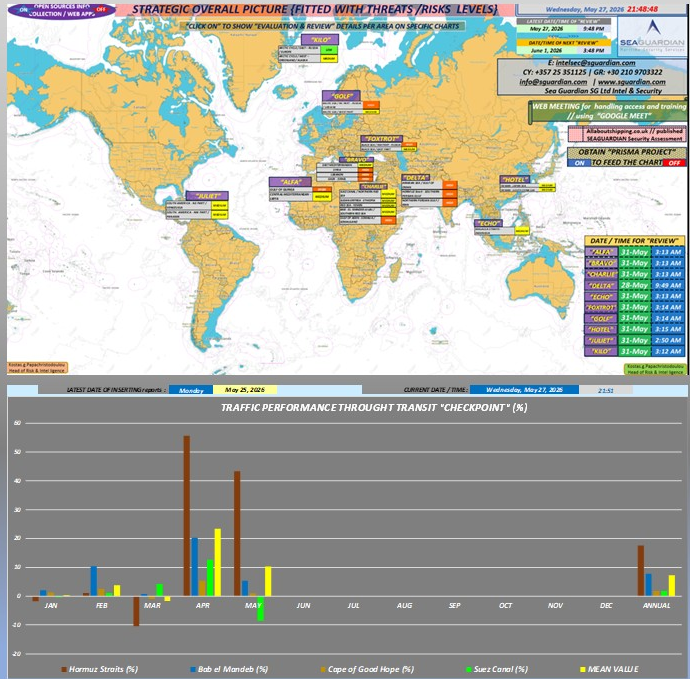
Sea Guardian S.G. Ltd / Intel Department (www.sguardian.com / (+30) 694 437 3465)
can support your operational planning, assist in determining the risk assessment and aid in decision making by producing tailor-made assessments upon request on ports, routes, cargos and specific merchant vessels. You can refer to our previous Threat & Risk Assessments for more information and background analysis on the events and situation for each specific region.
[return to CONTEXT TABLE]
ANNEX “B”: Security Assessment – Lessons Learned
| LESSONS LEARNED | ||
| INCIDENTS | REACTIONS | TRANSFORMATION NOTICES |
| The attacks on July 2025 in RED SEA | Permanent contact with the shipping company as well the maritime security company that hires security teams. | Developing independent international relations and operational apps for supporting crew recovery having abandoned the vessel. |
| The attacks on July 2025 in RED SEA | The active contingency plans and business impact analysis in case of discontinuation with the security guarding teams (such as an attack difficult to face with small arms). | Further implementation of maritime/ISO standards. |
| Inbound in an area of high military / paramili- tary threats with all navigational aids and AIS closed | Operate all the navigational aids and AIS/communication systems after having been attacked by ballistic or related missiles, when visual targeting was available due to the lack of international naval forces. | Stabilize the closed navigational aids to prevent targeting towards the necessity of giving information through them to friendly entities. |
| The detailed analysis after a special interview of security crew assessing decision-made | A fundamental decision involves choosing whether to abandon a sinking vessel using a lifeboat for safety, or to escape directly into the sea with only life jackets, while under the threat of attacking skiffs searching for survivors. | Balance the threat while abandoning the ship at sea with the threat of environmental and geographical conditions for survival. |
| The re-emergence of piracy in the Gulf of Aden-Horn of Africa and Somalia | From the latest incidents in the area, it was proven that the existence of Maritime security teams is of paramount importance, as well as the existence of International Maritime operations. | The overall security umbrella is achieved if: – A consistent/ coherent Security assessment has been done in advance – International Maritime operations in the region exist – The use of Security teams onboard for a wider area is available. |
Usefull links for conflict indexes and picture of piracy attacks in:
- ACLED and IMB/ICC for the war threat levels and International commerce crime incidents.
- Companies under sanction by Ukraine (Black Sea): Database of Legal Entities Under Sanctions
- https://www.youtube.com/watch?v=Pt6GS7QohAI, for an overall general assessment by the SEA GUARDIAN President presented at Naftemboriki TV (Shipping) for the latest period, covering the time-frame before and after the Houthis ballistic, drones and UCAV attacks.
[return to CONTEXT TABLE]
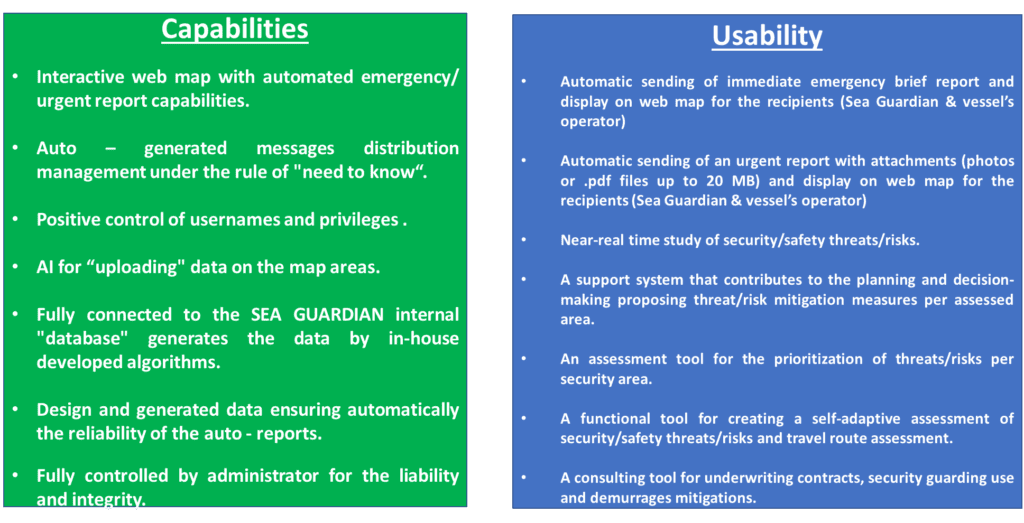
ANNEX “C”: The SEA GUARDIAN Data & Control Reporting system (DACOR)
DACOR system visualizes this report and covers the period between two successive monthly Security Assessments with near-real time data and reporting capabilities. It is ready to be provided as a subscription service hosted in SEA GUARDIAN servers.
| Contact us for a trial or fix an appointment: | or book a “google meet” appointment through the following global calendar: |
| E-mail: intelsec@sguardian.com | https://calendar.app.google/LmPSoo5fDxZMVq357 |
| CY:+35725351125|GR:+302109703322 info@sguardian.com | www.sguardian.com Sea Guardian SG Ltd Intel & Security |
